Wednesday, September 25, 2013

Cotton Mather

Boston, MA   Visited April 2006


I’ve wrestled with this post.  Cotton Mather is difficult to capture in simple biography.  Pious but strident, thoroughly puritan but enamored with the age of science, a man committed to broad Christian charity but defined most significantly in one of the darkest expressions of religious superstition in American history.  A fascinating and perplexing subject for the blog. 


Cotton Mather was born in Boston February 1663.  Both of his grandfathers – John Cotton and Richard Mather - were pastors who emigrated from a religiously hostile England and became prominent first generation New England Puritans.  Cotton Mather’s father, Increase Mather was perhaps the dean of Puritan pastors in the late 1600’s, as well as a president of Harvard College.  To be a prominent pastor was not simply a religious standing.  In Puritan New England governing and pastoring were closely aligned.  So Cotton Mather grew up with some big shoes to fill. 


Increase Mather - Cotton's Pappy

 
Early in life he showed both significant academic gifting and a heart to serve God.  He entered Harvard College at age twelve, graduated at fifteen  and, after further divinity study was ordained to the ministry at age eighteen.  Mather took his first pastoral position serving under his Father at the North Church – the figurative center of Puritanism in New England.  It seems that the younger Mather’s relationship with his father/superior was at times contentious, as Cotton Mather sought to distinguish himself and his ministry from the shadow of his illustrious father. 
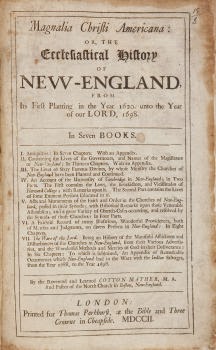


Mather's magnum opus - Magnalia Christi
Americana - a history of New England


Ultimately Cotton Mather found his place in his world primarily through his writing.  He was a prolific and diverse author, composing over 400 books in his lifetime on theology, politics, history and science.  Mather was one of the early colonial proponents of germ theory and inoculations – scientific ideas that many clergy members opposed.  He was also was an early proponent of hybridization in agriculture. 


It is indicative of Mather’s wide influence beyond the Puritan world that he developed a relationship with a young BENJAMIN FRANKLIN.  Historian John  Lienhard describes an incident that occurred on a visit by Franklin to Cotton Mather’s home.  Franklin had been an apprentice to one of Mather’s scientific critics, but found the preacher/scientist’s writing intriguing.   After a chat Franklin turned to leave. 

 “As Franklin was leaving, Mather shouted at him, "Stoop, stoop!"  Too late! Franklin struck his head on the low doorjamb, and Mather intoned: "You are young, and have the world before you; stoop as you go through it, and you will miss many hard thumps." Franklin did not miss the point. Later he said, "I often think of [Mather's words] when I see pride mortified, and misfortunes brought upon people by their carrying their heads too high."
 
Cotton Mather has no relation to, and should not be confused with:
 
Marshall Mathers, aka Eminen


Jerry Mathers, aka The Beaver

 
Unfortunately, to the larger world Cotton Mather is most well known in connection to the Salem Witch Trials of 1692.  This tragic incident in America history is one of the most difficult for those in the modern world to comprehend.  What seems to be true is that something happened among the people of the village of Salem that was unexplainable to the minds of 17th century New Englanders.  It is also clear that a superstitious populace and an ad hoc trial system sent innocent people to their deaths.  Mather is linked to the sad affair in two ways.  His political influence had helped place the key players in the trial in their governing roles before the events started happening.  And, though he was not directly involved in the proceedings, his commentary in writing on what was going on at the time seems to have validated the charges and outcomes of the trials. 
 
Two very different depictions of the witch trials:


In all honesty, as I’ve read several accounts of the trials, it is difficult to know what to make of Cotton Mather’s role.  He certainly had the influence to turn the trials in a different direction had he wanted to.  But his writings are somewhat contradictory. He seems to advocate on the one hand a careful and thorough investigation of what was taking place and argued against the death penalty, but provided the theological basis for the possibility of spiritual forces at work in the town upon which the convictions rested. 
 
Cotton Mather's home on Hanover Street in Boston


Cotton Mather’s later years were filled with difficulty.  He had two wives die and his third wife reportedly went mad.  He fathered fifteen children but only two outlived him.  His role in the Salem trials brought criticism throughout his remaining life.  And the zeal for godliness and a fully Christian community that characterized the early years of American Puritanism began to give way to liberalism and division even as Mather sought to preach and lead and write against the secular tide.  However, as he aged he turned more and more to intercessory prayer, particularly prayer for revival of true Christian religion in new England.  On February 13, 1728, one day after his 65th birthday, Cotton Mather died in Boston.  His prayer for revival had not been answered in his lifetime, but within a few short years the Great Awakening  broke out – a revival of the very Puritan theology that Mather and his family had worked so hard to promote in the New World. 


All of the Mathers are buried in a single simple tomb at historic Copp’s Hill Burial Ground.  It is a beautiful spot overlooking Old North Church in one direction and Breed’s and Bunker Hills across the Charles River in the other.  (I found this short amateur Video somebody made on a tour as they walked through the cemetery on the way to the Mather site).  Copp’s Hill is the second oldest burial ground in Boston and is directly on the Freedom Trail.    As my picture (and the video) show, the tomb was in a sad state of disrepair.  I would love to see more made of this historic family and their contribution to the religious and cultural heritage of our country.  But the sad irony is that the Mathers and the Reformed theology they espoused are both disregarded in the New England that owes so much of its character to their formative influence. 


Maybe Cotton Mather's own words offer a helpful perspective on posterity:
 
 
“History is the story of events, with praise or blame.”


Your blogger at the Mathers tomb


Cotton Mather has had a couple of interesting pop culture incarnations since he passed from the scene.  Marvel comics created a villain for the Spider Man series in the seventies called Cotton Mather.  Here’s a description:
 
 
Powers/Abilities: Mather powers' origin are unknown (probably they were granted to him by the Dark Rider). Mather could sense and find magic beings, project his voice (or thoughts) at very long distances, control and command other's will by touching them or hitting them with the fire shot from his wooden cross. Mather seemed stronger than a normal human. Mather used a wooden cross as weapon. The cross could shoot a "purifying" fire, not burning things, but strong enough to hurt Spider-Man and drive the Vision off. The fire also allowed him to control Scarlet Witch's will.


A little more image-friendly tribute came in the form of the 1990’s Austin, Texas band Cotton Mather.  The alt/pop band became an underground sensation particularly in England with the release of their self-produced album Kontiki.   It was re-released in 2012.  Here’s a promo for it. 


Saturday, August 31, 2013

Jimmy Stewart

Los Angeles, CA Visited June 2013


This post is an opportunity to highlight my favorite actor – Jimmy Stewart. Over a career spanning six decades Jimmy Stewart carved out legacy as one of the enduring Hollywood legends who also served his country with distinction in the armed forces. His is a story worth its own movie.


James Stewart at a Princeton ma  

James Maitland Stewart was born May 20, 1908 in Indiana, PA to a small town hardware store owner. His family was devoutly Presbyterian, a faith that Stewart adhered to with various resolve throughout his life. Young Jimmy went to prep school, played sports and worked in manual labor during summer recess. Submitting to his father’s desire he enrolled at Princeton University. It was at Princeton that he got his first taste of acting. After graduation he joined a drama company that included an actor who would become a life-long friend, Henry Fonda. While both found work acting on Broadway it was Fonda’s initial success in movies that paved the way for Stewart to sign a contract with MGM.


James Stewart (his chosen film name) got his first substantial role in After the Thin Man in 1936. Two years later he teamed with Frank Capra for the first time to a achieve a star-making role in You Can’t Take it With You. 1939 was the year Stewart cemented his place as a top star with his first western, Destry Rides Again and Mr. Smith Goes to Washington. In 1940 he starred with Cary Grant and Katharine Hepburn in The Philadelphia Story. While he was nominated for five Academy Awards in his career, he won his only Oscar for best actor his role as newspaperman Macaulay Connor in this film.


Stewart statue in his hometown of Indiana, PA


With the outbreak of World War II James Stewart was drafted but almost didn’t receive military admittance due to his height/weight ratio. But the actor was resolute in his commitment to serve in active duty. His family had a long military history. Jimmy Stewart was a direct descendent of veterans of the American Revolution and the War of 1812. His grandfathers had fought in the Civil War; his father had fought in the Spanish American War and World War I. Stewart went into the army as a private with intention to join the air corp. It took him over two years to work his way through to his wish to fly in battle but he finally flew his first combat mission as commander of a squadron of B-24 Liberator bombers. By the end of the war James Stewart had been awarded the distinguished flying cross and risen from the rank of private to full colonel in just four years. Following the war Stewart transferred to the reserves, retiring as a brigadier general in 1968.


A true pre-mission photo - not a publicity picture


At the end of the war James Stewart considered not returning to the movie business but was coaxed back into pictures by Frank Capra to do It’s a Wonderful Life. The movie garnered him another Academy Award nomination but it didn’t do well in its initial run. However, due to a lapse in ownership rights the movie wound up in the public domain for a number of years and has been subsequently recognized as one of the most popular movies of all time. Ultimately Jimmy Stewart’s career reached its real potential in the post war years through collaborations with Alfred Hitchcock (Rope, Rear Window, Vertigo, etc.) and in well regarded Westerns (Winchester 73, The Man Who Shot Liberty Valance, and How the West was Won, among others). He also starred in the both the Broadway and film versions of Harvey. Jimmy Stewart’s film career took him well into his seventies. In a poignant late-career supporting role Stewart played a doctor diagnosing John Wayne’s aging gunfighter with terminal cancer in The Shootist – Wayne’s final film made while he was in his own cancer fight. Jimmy Stewart’s last credited role was a voice performance as sheriff Wiley Burp in An American Tale – Fievel Goes West.


My daughter Kelsey at Jimmy Stewart's spot at Grauman's Chinese Theater May 2005

Your blogger at Grauman's - June 2013


One thing that set Jimmy Stewart apart in Hollywood was his marriage. After living his early years as something of a Hollywood playboy he met a former model named Gloria McClean. Wed in 1949, their marriage lasted 45 years until her death in 1994. This long and devoted marriage is just one aspect of his life that distinguished Stewart in Hollywood. He was, by all accounts a genuine and self-effacing man whose iconic on-screen demeanor was reflective of his off-screen personality. Stewart was a life-long political conservative in the mold of his friend Ronald Reagan; in addition he was a shrewd businessman and generous philanthropist to causes he cared about.


Jimmy and Gloria Stewart with President Ronald Reagan in 1986


A quirky aspect of Jimmy Stewart’s late career were his appearances on Johnny Carson’s Tonight Show. He would often recite a droll self-composed poem. You can view one classic moment as Stewart shares a poem about his dog Beau.  If you watched that then you really need to see Dana Carvey's spoof of Stewarts poetry reading on Saturday Night Live.


James Stewart died of heart disease at 83 in Hollywood, California on July 2, 1997, surrounded by family and friends. Following a memorial service attended by over three thousand mourners he was laid to rest next to his beloved wife Gloria at Forest Lawn-Glendale Cemetery. In the years following his death the American Film Institute rated James Stewart as third greatest actor in film history. One of my favorite scenes with Jimmy Stewart is his  dialogue with Cary Grant in The Philadelphia Story. 


There’s a great anecdote that Jimmy Stewart told to "Guideposts" magazine back in 1977 that gives a sense of where the actor and the man came together.  In the film It’s a Wonderful Life George Bailey (Stewart) is,

"unaware that most of the people in town are arduously praying for him. In this scene, at the lowest point in George Bailey's life, Frank Capra was shooting a long shot of me slumped in despair. In agony I raise my eyes and following the script, plead, 'God...God...dear Father in heaven, I'm not a praying man, but if You're up there and You can hear me, show me the way, I'm at the end of my rope. Show me the way, God...'

 "As I said those words, I felt the loneliness and hopelessness of people who had nowhere to turn, and my eyes filled with tears. I broke down sobbing. This was not planned at all, but the power of that prayer, the realization that our Father in heaven is there to help the hopeless had reduced me to tears."


Jimmy Stewart's Grave at Forest Lawn
James Stewart is buried at Forest Lawn Cemetery – Glendale, one of the largest cemeteries in California. When my son Grant and I were on a trip out to California I talked him into checking out some cemeteries along the way. He had no idea what he was agreeing to. The actor is buried next to his wife on a hillside under a simple plaque containing the words of Psalm 91:11: For he shall give his angels charge over thee, to keep thee in all thy ways.


James Stewart appeared in 84 films during a career that ran from 1935 to 1991. My top five favorite Jimmy Stewart films are

#5 - Shenandoah


#4 - Destry Rides Again   


#3 - The Philadelphia Story


# 2 - Mr. Smith Goes to Washington  


#1 - Its a Wonderful Life 


Saturday, June 8, 2013

Seattle Slew

Lexington, KY.   Visited October 2011


It’s 2013 and for the thirty-fifth year in a row we will not have a Triple Crown winner in horseracing. But that doesn’t mean we don’t have a worthy blog candidate for our annual race horse entry. So here’s to the only horse ever to win the Triple Crown with an undefeated record. The great Seattle Slew.


Seattle Slew is perhaps the most unlikely Triple Crown winner in history. He was born (foaled) in February 1974 in Lexington, KY. A year later he was rejected for the prestigious Keenland Sale and sold at auction (the only Triple Crown winner ever acquired in this somewhat pedestrian way) for a relatively paltry $17,500. The purchasers were two couples who were relative novices to horseracing. They actually spent $2,500 more than they had budgeted to get him. The yearling was named for the hometown of one of the owners and for a swamp in Florida (a ‘slew) purchased by the others.


Though he was well-sized for racing, Seattle Slew had a birth defect (a reason he was so cheap) that caused his right front foot to sway out when he ran. One of his owners said, "He looks like a crab, a bad crab". His trainer, Billy Turner took to calling him Baby Huey in his early training. But nobody denied that he was fast – faster than any of them had thought possible. The horse was taken to New York to train for his inaugural two year old racing season. That first season (1976) he won three races and was named Two Year Old of the Year.


Seattle Slew down the stretch of
the Kentucky Derby


In his 1977 Triple Crown season Seattle Slew ran three prep races culminating in a 3 ¼ length victory in the Wood Memorial. He therefore came into the 1977 Kentucky Derby with a 6-0 record and was installed as a 1-2 favorite. Though typically a speed horse who liked to run at the front of the pack, Seattle Slew stumbled out of the gate, cut his mouth and found himself near the back of a 14 horse field. But under the guide of jockey Jean Cruget he quickly recovered, picked his way through the crowd and beat the field by almost two lengths.  Watch Seattle Slew's Derby run here


Me and my friend Mark
Prater at Churchill Downs


Outstanding SI cover of Slew's
Belmont finish

Two weeks later in the Preakness, Slew outdueled Cormorant by 1½ lengths. On June 11, 1977 Seattle Slew returned to his home track to run in the Belmont Stakes as the overwhelming favorite. Breaking out under the lead of Cruget in the classy black and gold silks, Slew led virtually wire to wire to win by four lengths to extend his win streak to 9 for 9 in becoming the tenth Triple Crown winner in history. 


You can watch Slew's Belmont triumph here .


Three weeks later, probably due to over-racing, Seattle Slew’s winning streak was snapped as he finished a distant fourth in the Swaps Stakes. In spite of this loss he was acclaimed Horse of the Year for 1977. Not long after the Swaps Stakes the horse developed a respiratory infection that sidelined him for nearly a year. These days that would mean certain retirement to stud. But by May 1978 the horse had recovered and he was racing as a four year old.


Seattle Slew winning the 1978 Marlboro Cup

In September 1978 he helped make history by participating in the first race between Triple Crown winners when he ran in the Marlboro Cup against 1978 Triple Crown winner Affirmed. Both horses had only lost once in their careers. Affirmed was the favorite in the race but Slew took the lead early and held off a late charge by Affirmed to win by three lengths. You can watch the historic Marlboro Cup race here.   In a rematch two races later both horses were beaten.


Seattle Slew retired at the end of his four year old season with a record of 14-3 and was named Older Horse of the Year – the third top award of his three year career.  He spent his retirement in stud at several Lexington farms, ending up at Hill ‘n’ Dale Farms. Slew is considered to have been a successful breeding horse, siring multiple stakes winners, the most prominent of which was Swale, winner of the 1984 Kentucky Derby and the Belmont.

Sign for Hill 'N' Dale Farm in Lexington


In his later years the horse suffered from various ailments. On May 7, 2002, exactly 25 years after he won the Kentucky Derby, Seattle Slew died in his sleep. He was 28 years old. He is buried at Hill ‘n’ Dale Farm in Lexington.


The last known picture of an elderly
Seattle Slew

On a trip to Louisville for a conference I took an extra day to drive out to Lexington to do some touring. I had contacted Hill ‘n’ Dale Farms to arrange a visit. It was pouring rain and I was running late so when I got to the farm the gate was locked. I called the office and, amazingly, they just opened the gate and let me drive into the farm (which is still a first class thoroughbred breeding farm) and drive back to the stable area where Slew is buried. He is commemorated with a very classy black marble memorial area and a bronze statue.

Beautiful spot on a very rainy day


Note the blogger's calling card Phillies cap
verifying the visit


In 1999 Bloodhorse Magazine named Seattle Slew the ninth greatest racehorse of all time. Perhaps the most resonant epitaph for Slew comes from John Sikura, owner of Hill ‘n’ Dale Farms,


"It was one of the great privileges to be around something great, a feeling that will likely never be duplicated," he said. "He was one in a million, and showed us there is that possibility in a game of impossibilities."


Monday, April 15, 2013

Benjamin B. Warfield

Princeton, New Jersey Visited August 2012


Benjamin Breckenridge Warfield was one of the titans of the Reformed faith at the turn of the 20th Century. In an age where the very essence of Biblical Christianity was being undermined by theological liberalism, "The Lion of Princeton" stood for the historic orthodox doctrine of the Faith with a towering intellect and prodigious commitment to written theological argument.


The young Warfield circa 1864


Benjamin Warfield was born in 1851 in Lexington, Kentucky into the aristocratic Breckenridge clan. Warfield’s maternal grandfather was a professor of theology who was a staunch supporter of the Union cause in the Civil War. His uncle, John Breckenridge was Vice President in the Buchanan administration and became a well regarded general in the Confederate army. Warfield himself was a Unionist committed to the civil rights of African Americans throughout his life. Benjamin was raised in a thoroughly Reformed home and professed saving faith in Christ at sixteen, but did not appear to have much interest in the ministry or theological pursuits early in life.


Warfield attended Princeton College where he excelled in the sciences. Upon graduation he sought to continue study in Europe. It was in Europe that B. B. Warfield "realized the paramount claims of God and religion upon him", and accepted God’s call to preach the Gospel – to the utter surprise of all who knew him. He came back to the United States and enrolled at Princeton Seminary, graduating in 1876.  He was ordained to the ministry in the Presbyterian Church.


The year 1876 was pivotal in Warfield’s life beyond his ordination. In August of that year he married Anne Kinkead. They traveled in Europe for their honeymoon. Hiking in the mountains, they encountered a severe thunderstorm. A lighting strike nearby physically and emotionally traumatized Anne. The effect of this event was to have a lifelong impact on the Warfields. Anne returned to the U.S. in an invalid state and became a virtual recluse for the rest of her life. This tragedy at the beginning of his marriage became the defining reality for B. B. Warfield. For the rest of his life the care of his wife was his highest priority. He left pulpit ministry early for seminary professorship where he could arrange his schedule around her care. From this point on he never traveled or spent more than a couple of hours away from Anne. With the death of the legendary A. A. Hodge, B. B. Warfield returned to his alma mater in 1886 where he took up a life-long professorship in systematic theology.


Providentially, it was a combination of Warfield’s energetic intellectual gifts and his devotion to his wife which led to a ministry of singular significance in the cause of the Gospel. Not noted for his preaching skills, B. B. Warfield devoted himself to writing and publishing theological works that rival Luther and Calvin in scope and volume. It was the self imposed limits on travel and extra-curricular activity that allowed him to give his time to the study and composition of this work. Warfield’s theological output was devoted to articulating classic Reformed theology in an age of modernist thought and liberal attacks on the inerrancy and authority of Scripture. His writings remain remarkably accessible and compelling today. With contemporaries Abraham Kuyper and Herman Bavinck, B. B. Warfield carried the Reformed theology of Calvin, Edwards and Hodge through the modernist movement and sent it into the 20th Century era with compelling intellectual force.


Warfield in his study

Recent Warfield biographer Fred Zaspel was inteviewed by Justin Taylor from the Gospel Coalition on what he learned about Warfield the man.    

This is one of things that attracted me to Warfield—more than most any other I’d read he understands Christianity “whole” and finds Christ crucified at the very center. He sees both the forest and the trees and understands all as pointing to this redemptive center. And for Warfield personally this was no merely academic discovery, but he is himself marked by a keen sense of utter dependence upon Christ, and his own heart beat hot for his glorious Redeemer.


Anne Warfield died in 1915, and B. B. Warfield continued on in his ministry for six more years. They never had any children. Warfield worked hard till the very end. He suffered a minor stroke Christmas Eve, 1920.  Then on a walk across campus in February 1921 he suffered a heart attack from which he would not recover. Benjamin Breckinridge Warfield died on February 16, 1921 ending a 33 year career of scholarship at Princeton Seminary. In a sad irony, Warfield, Bavinck and Kuyper all passed into glory within nine months of each other.


Your blogger with Warfield


Map of Old Princeton Cemetery


Benjamin B. Warfield is buried in Old Princeton Cemetery. It’s actually a bit challenging to find his grave since it is not in the Edwards/Hodge section. I've been there several times, most recently with a group of pastors, theology students and missionaries on a one day tour of Great Awakening sites.  We ended our tour at Princeton Cemetery. 

Tour dudes with the Warfields - Anne Warfield to the left


Here’s a wonderful quote from Warfield that captures the clear Gospel centeredness of all his work.

Our faith itself, though it be the bond of our union with Christ through which we receive all His blessings, is not our saviour. We have but one Saviour; and that one Saviour is Jesus Christ our Lord. Nothing that we are and nothing that we can do enters in the slightest measure into the ground of our acceptance with God. Jesus did it all.

Wednesday, March 27, 2013

Henry V

London, England Visited November 1997


I’ve made two visits to Westminster Abbey but have never put one of the notables buried in the cathedral into this blog because they never let me take pictures in the cathedral. My typical policy: no picture, no post. But I’ve lifted the ban because there are some great stories to be told.  And I've got a cheesy picture of me in front of the church verifying my visit. 

I’ve decided to begin with King Henry V, mostly because of an unexpected 24-hour Henry-fest that my brother and I took in cold, rainy Londtontown back in 1997. But first some bio.


Laurence Olivier as
Henry V
The man who became Henry V was born in Wales as Henry of Monmouth in 1386. His father was King Henry IV of the House of Lancaster. In the convoluted world of the British monarchy young Henry’s cousin Richard II was king during his youth. Henry IV was exiled and Henry V was actually a ward of Richard II when his father Henry IV led an uprising against Richard II leading to an overthrow of the monarchy. This established Henry IV on the throne and made Henry V Prince of Wales. You might need to read that again to follow the plot.


Contrary to Shakespeare's take, Henry V had already distinguished himself as a soldier in his teenage years – a trait that would define the entirety of his life. At the age of 16 during the Battle of Shrewsbury he was shot in the face with an arrow. It stuck and the extraction left him with a significant scar. Henry ascended to the throne upon his father’s death in 1413. History seems to portray Henry as a strong but politically balanced sovereign, who demonstrated an ability to decisively put down potential rebellions while building a stable and prosperous regime.


Ian McKellan as Henry V


Henry V praying at Agincourt

But it is Henry’s foreign policy that he is most known for – specifically his nearly obsessive intentions to conquer France. Henry felt he had a sovereign right to rule France and set about campaigning (militarily) to that end. His military career is ultimately defined by his victory over the French at the Battle of Agincourt. Agincourt is a remarkable victory by any standards. At the time of the battle the English army was decimated by sickness and malnutrition. While troop estimates vary widely most reliable numbers indicate that going into battle the French forces outnumbered the British 4 or 5 to 1. It should have been a slaughter. But almost miraculously the English crushed the superior French forces on the field. In fact the victory was so decisive that scholars generally estimate that the French casualties outnumbered the English by a ratio of 9 to 1!


Christopher Plummer as
Henry V


Richard Burton as
Henry V
 

Kenneth Branagh as
Henry V


Eventually Henry was able to use Agincourt and other victories to establish his claim as regent of France. His legitimacy was cemented with his marriage to Katherine of Valois, the French King’s daughter. However, even with titular rule over France, Henry never stopped trying to extend his actual power on the continent. On a campaign in 1422 Henry became ill and died at the age of 35. He was brought back to London and buried in Westminster Abbey. The next in line for the throne was his infant son Henry VI. But the regency in place during Henry VI 's youthful reign largely squandered Henry V’s conquests and the monarchy stayed in decline until the reign of Henry VIII.


Michael Sheen as Henry V from the playbill
for the Fall 1997 RSC production


Your blogger at the
Globe Theatre
The 24 Hour Henry-a-Thon. My brother John and I were in London for a few days in November 1997. We decided to take an afternoon tour of the Globe Theatre on the south side of the Thames, which had been rebuilt on the original site. Taking a tour gave us a jones for Shakespeare, so we found a pay phone and called up the Royal Shakespeare Company and found out they were doing a performance of “Henry V” that night.


We bought two back row tickets by phone, then realized that we needed to get to the other side of the Thames, which meant crossing the Tower Bridge. Leaving the theatre we were confronted by a mob of people – it was the night that the Royal Yacht Britannia was decommissioned and sailed for the last time out of the city. After fighting through the crowds we crossed the Bridge and made it to the Barbican Theatre where the performance was to take place.


We went up to get our tickets and were told that there were two second row seats we could have instead of our last row seats. Snagging them, we sat down in our seats and proceeded to be blown away by an a amazing performance featuring Michael Sheen (who later played Tony Blair in ‘The Queen’ and David Frost in “Frost/Nixon”) in the title role. 


Ticket from the play

It was the first time I'd seen the play and it has been my favorite Shakespeare ever since. Kenneth Branagh's 1989 film version is a must see.  His St Crispin's Day (Band of Brothers) speech is one of the most stirring rallying cries you'll ever see on film. 


''We few, we happy few, we band of brothers'


A little-known extra benefit is watching Branagh carry a fifteen year old Christian Bale over his shoulder at the end of the movie.   


Your blogger at Westminster


Being in London, it only made sense to make a pilgrimage to Henry's final resting place. So, the next afternoon we headed to Westminster Abbey. It so happens that Henry’s crypt was in the midst of a restoration so it was hard to see it, but I was there. And that’s what makes Henry V a great subject for this blog.


Henry V tomb in Westminster Abbey

The tomb of Henry V is prominently located
behind the royal Coronation Chair