Showing posts with label Scientists. Show all posts

Wednesday, September 25, 2013

Cotton Mather

Boston, MA   Visited April 2006


I’ve wrestled with this post.  Cotton Mather is difficult to capture in simple biography.  Pious but strident, thoroughly puritan but enamored with the age of science, a man committed to broad Christian charity but defined most significantly in one of the darkest expressions of religious superstition in American history.  A fascinating and perplexing subject for the blog. 


Cotton Mather was born in Boston February 1663.  Both of his grandfathers – John Cotton and Richard Mather - were pastors who emigrated from a religiously hostile England and became prominent first generation New England Puritans.  Cotton Mather’s father, Increase Mather was perhaps the dean of Puritan pastors in the late 1600’s, as well as a president of Harvard College.  To be a prominent pastor was not simply a religious standing.  In Puritan New England governing and pastoring were closely aligned.  So Cotton Mather grew up with some big shoes to fill. 


Increase Mather - Cotton's Pappy

 
Early in life he showed both significant academic gifting and a heart to serve God.  He entered Harvard College at age twelve, graduated at fifteen  and, after further divinity study was ordained to the ministry at age eighteen.  Mather took his first pastoral position serving under his Father at the North Church – the figurative center of Puritanism in New England.  It seems that the younger Mather’s relationship with his father/superior was at times contentious, as Cotton Mather sought to distinguish himself and his ministry from the shadow of his illustrious father. 
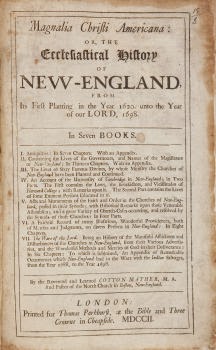


Mather's magnum opus - Magnalia Christi
Americana - a history of New England


Ultimately Cotton Mather found his place in his world primarily through his writing.  He was a prolific and diverse author, composing over 400 books in his lifetime on theology, politics, history and science.  Mather was one of the early colonial proponents of germ theory and inoculations – scientific ideas that many clergy members opposed.  He was also was an early proponent of hybridization in agriculture. 


It is indicative of Mather’s wide influence beyond the Puritan world that he developed a relationship with a young BENJAMIN FRANKLIN.  Historian John  Lienhard describes an incident that occurred on a visit by Franklin to Cotton Mather’s home.  Franklin had been an apprentice to one of Mather’s scientific critics, but found the preacher/scientist’s writing intriguing.   After a chat Franklin turned to leave. 

 “As Franklin was leaving, Mather shouted at him, "Stoop, stoop!"  Too late! Franklin struck his head on the low doorjamb, and Mather intoned: "You are young, and have the world before you; stoop as you go through it, and you will miss many hard thumps." Franklin did not miss the point. Later he said, "I often think of [Mather's words] when I see pride mortified, and misfortunes brought upon people by their carrying their heads too high."
 
Cotton Mather has no relation to, and should not be confused with:
 
Marshall Mathers, aka Eminen


Jerry Mathers, aka The Beaver

 
Unfortunately, to the larger world Cotton Mather is most well known in connection to the Salem Witch Trials of 1692.  This tragic incident in America history is one of the most difficult for those in the modern world to comprehend.  What seems to be true is that something happened among the people of the village of Salem that was unexplainable to the minds of 17th century New Englanders.  It is also clear that a superstitious populace and an ad hoc trial system sent innocent people to their deaths.  Mather is linked to the sad affair in two ways.  His political influence had helped place the key players in the trial in their governing roles before the events started happening.  And, though he was not directly involved in the proceedings, his commentary in writing on what was going on at the time seems to have validated the charges and outcomes of the trials. 
 
Two very different depictions of the witch trials:


In all honesty, as I’ve read several accounts of the trials, it is difficult to know what to make of Cotton Mather’s role.  He certainly had the influence to turn the trials in a different direction had he wanted to.  But his writings are somewhat contradictory. He seems to advocate on the one hand a careful and thorough investigation of what was taking place and argued against the death penalty, but provided the theological basis for the possibility of spiritual forces at work in the town upon which the convictions rested. 
 
Cotton Mather's home on Hanover Street in Boston


Cotton Mather’s later years were filled with difficulty.  He had two wives die and his third wife reportedly went mad.  He fathered fifteen children but only two outlived him.  His role in the Salem trials brought criticism throughout his remaining life.  And the zeal for godliness and a fully Christian community that characterized the early years of American Puritanism began to give way to liberalism and division even as Mather sought to preach and lead and write against the secular tide.  However, as he aged he turned more and more to intercessory prayer, particularly prayer for revival of true Christian religion in new England.  On February 13, 1728, one day after his 65th birthday, Cotton Mather died in Boston.  His prayer for revival had not been answered in his lifetime, but within a few short years the Great Awakening  broke out – a revival of the very Puritan theology that Mather and his family had worked so hard to promote in the New World. 


All of the Mathers are buried in a single simple tomb at historic Copp’s Hill Burial Ground.  It is a beautiful spot overlooking Old North Church in one direction and Breed’s and Bunker Hills across the Charles River in the other.  (I found this short amateur Video somebody made on a tour as they walked through the cemetery on the way to the Mather site).  Copp’s Hill is the second oldest burial ground in Boston and is directly on the Freedom Trail.    As my picture (and the video) show, the tomb was in a sad state of disrepair.  I would love to see more made of this historic family and their contribution to the religious and cultural heritage of our country.  But the sad irony is that the Mathers and the Reformed theology they espoused are both disregarded in the New England that owes so much of its character to their formative influence. 


Maybe Cotton Mather's own words offer a helpful perspective on posterity:
 
 
“History is the story of events, with praise or blame.”


Your blogger at the Mathers tomb


Cotton Mather has had a couple of interesting pop culture incarnations since he passed from the scene.  Marvel comics created a villain for the Spider Man series in the seventies called Cotton Mather.  Here’s a description:
 
 
Powers/Abilities: Mather powers' origin are unknown (probably they were granted to him by the Dark Rider). Mather could sense and find magic beings, project his voice (or thoughts) at very long distances, control and command other's will by touching them or hitting them with the fire shot from his wooden cross. Mather seemed stronger than a normal human. Mather used a wooden cross as weapon. The cross could shoot a "purifying" fire, not burning things, but strong enough to hurt Spider-Man and drive the Vision off. The fire also allowed him to control Scarlet Witch's will.


A little more image-friendly tribute came in the form of the 1990’s Austin, Texas band Cotton Mather.  The alt/pop band became an underground sensation particularly in England with the release of their self-produced album Kontiki.   It was re-released in 2012.  Here’s promo for it. 


Friday, November 25, 2011

Galileo Galilei

Florence Italy – July 2010


Galileo Galilei embodies the wrenching philosophical and theological collision that occurred as a result of the Renaissance. He’s called by Albert Einstein ‘the father of modern science’, yet his life and ideas were shaped profoundly by his experience with the medieval Catholic Church. I had the chance to see Galileo’s tomb at Santa Croce during a trip to Florence, Italy with my brother and daughter Kelsey and her friend Sarah a couple of years ago. There will be more entries from this amazing historic site in the future.


Galileo's telescope

Galileo was born in Pisa, Italy in 1564, the day of Michelangelo’s death, in the same year as William Shakespeare's birth. Early in his life Galileo considered entering the priesthood, but eventually chose to study mathematics at the University of Pisa. Upon completion of his degree the gifted young scholar took a position at the Accademia in Florence, where his family had moved when he was a youth. But it was as a professor at the University of Padua where Galileo’s greatest scientific theories and the controversies surrounding them emerged.

Galileo distinguished himself in a number of fields, particularly making significant advances in the development of the telescope. But it was his embrace of Copernican astronomy that brought him both fame and clerical opposition. Copernicus’ (1473-1543) theory that the earth was not the center of the universe had been condemned by the church. Through his own scientific inquiry Galileo came to adopt heliocentrism – the position that the sun was the center of the universe.


Galileo's recantation


In 1615 his advocacy of this position brought rebuke from the Roman Inquisition. Responding to this rebuke Galileo agreed to no longer teach on the view. But in 1632 Galileo published his “Dialogue Between Two World Systems” where he sought to present the worldview controversy as a reasoned discussion (which ultimately favored heliocentrism). The Vatican was not impressed, and subsequently convicted Galileo of heresy, banning the publication of any of his works extant or to be written in the future. He was also sentenced to house arrest for the remainder of his life. Galileo lived another ten years after this controversy, dying at the relatively advanced age of 77 in 1642.  In 1992 Pope John Paul II rescinded the condemnation of Galileo by the church.


For a contemporary take on Galileo check out this video of Irish singer Declan O'Rourke doing his song "Galileo - Someone Like You".  


Painting of Galileo's Inquisition


Galileo is buried in the Basilica of Santa Croce in Florence, immediately across the main sanctuary area from Michelangelo

My daughter Kelsey - the Vanna White of Santa Croce - in front of
of Galileo's tomb - Galileo's image is carved looking to the stars

What I find interesting about Galileo is that he is not the anti-religious rationalist of the Scientific Revolution that he is so often characterized to be. While he was a man with moral shortcomings (bearing two illegitimate daughters with a mistress), he was a scholar who approached the scientific endeavor with a deeply theological bent. Galileo did not see himself as a man caught between scripture and science but between the church and science. His views were actually not inconsistent with those of the Reformer John Calvin. He had a high view of the inerrancy and authority of scripture, and considered the erroneous doctrine of an earth-centered universe as an issue of poor interpretation and reading into texts by the church. Galileo believed that scripture, as rightly understood, would not contradict valid scientific evidence. The words Galileo desired to be carved as his epitaph at the end of his life speaks to his deeply God-centered view of his life and scientific pursuits.

“To the Lord; whom I worship and thank;

That governs the heavens with His eyelid

To Him I return tired, but full of living.”


Statue of Galileo at the Uffizi Plaza
in Florence


Other blog subjects buried at Santa Croce:

Michelangelo

Monday, February 28, 2011

Thomas Jefferson

Monticello, Virginia – Visited July 2006


Thomas Jefferson, third president of the United States, primary author of the Declaration of Independence, patriot, statesman, inventor. It is not hard to put TJ in the top tier of American icons. But Jefferson is also one of the most enigmatic figures in U. S. history – great statesman who was a poor public communicator; revolutionary war hero who never fought a battle, aristocratic owner of a huge estate yet virtually broke at the time of his death, eloquent spokesman for human freedoms, yet owner and exploiter of slaves.


Thomas Jefferson was born in April 1743 in the Virginia Colony to a successful planter with aristocratic status. He inherited the estate of his father in the foothills of the Blue Ridge and renamed it Monticello, which in Italian means ‘little mountain’. The great house of Monticello was Jefferson’s design, lifelong home, and the great passion of his life. Jefferson married in his late 20’s, and he and his wife had six children before her untimely death ten years later. Jefferson never remarried.


The Jefferson Memorial

Jefferson’s career as a lawyer began with graduation from William and Mary College, followed by a law practice and various local government positions; ultimately serving in the Virginia House of Burgesses. He was sent as a Virginia representative to the Continental Congress and in 1776 was chosen to be principle drafter of the Declaration of Independence. After independence Jefferson returned to Virginia to serve as state legislator and governor. He resumed national politics as part of the Congress of the Confederation, where he was selected to the key political ambassadorship to France. He returned from France to serve as the first Secretary of State under Washington.


Thomas Jefferson became vice president under John Adams and was reluctantly nominated for the presidency to succeed Adams and became the third President of the United States. Jefferson served two terms which included the Louisiana Purchase and the Lewis and Clark Expedition. Following his presidency Jefferson returned to Monticello, where he busied himself with developing his property, scientific experimentation and founding the University of Virginia. Jefferson sold his library to the U. S. Government, which became the formative collection of the Library of Congress. In one of the great ironies of American history, both Jefferson and John Adams died on the fiftieth anniversary of the ratification of the Declaration of Independence, July 4, 1826. He was buried in the family graveyard at Monticello.


Me and Melissa at Jefferson's grave


I’m not a big Jefferson fan. His Sally Hemmings scandal certainly cuts against the image of him as champion of equality. On the ‘American Patriots – Christian or deist’ scale, Jefferson’s a pretty solid ‘2’ (1 being ‘Humanist to the Max’ and 10 being ‘Evangelical and Vocal About it'). He’s the guy who cut the supernatural stuff out of the Bible to make his own humanist version.  But he did support separation of church and state, which has generally benefitted the cause of the Gospel over the large sweep U. S. history.  For a nice brief dramatization of Jefferson's humanistic perspective check out Jefferson and Adams debate from David McCullough's "John Adams"

Farmer gang loitering in front of TJ's crib

 My visit to Monticello occurred during a very hot summer vacation with the Farmer clan 180 years after his death. The day after we took a memorable and enlightening tour of Jefferson’s remarkable homestead, we played miniature golf. Only in America. Thanks Tom, for helping to make the ‘pursuit of happiness’ part of my cultural experience.


Jefferson in Paris - a statue along the Seine honoring the ambassador.
Jill and I came across it in a visit in May 2009


Thursday, August 19, 2010

Benjamin Franklin

Philadelphia, Pennsylvania.  Visited July 2004


To live in Philadelphia is to be surrounded by Ben Franklin. Streets, banks, stadiums, bridges, malls, museums all carry his name. And the man wasn’t even born here. Ben Franklin was actually born in Boston, January 1706, however there is no hint he ever rooted for the Red Sox.

The basics of Franklin’s life are rattling around the brain of anyone who ever took American History. The fifteenth of seventeen children, he ran away from home to Philadelphia at age 17, where he fell into the printing trade and gradually built a business as a publisher. His colorful life included a common law marriage that lasted 44 years, an illegitimate son who would grow up to be a British governor of New Jersey during the Revolutionary War (and thus Ben’s enemy), a legacy of scientific discoveries, and a key role in drafting the Declaration of Independence.  As a diplomat he represented the Colonies in the courts of both England and France. Franklin’s significance as a founding father is evident in the simple fact that he was a signer of both the Declaration of Independence and the Constitution.

Probably my favorite Franklin story is told by David McCullough in his book John Adams, where Franklin and Adams were sent by the Continental Congress to meet with the British commander Lord Howe. Stopping overnight at an inn, the two rotund statesmen found themselves sharing a bed in a room with only one small window. They spent the evening arguing over whether keeping the window open or shut would provide greater risk for sickness; debating two equally wrong personal theories of germ spread. (McCullough, 154-55)

Grant and I on the Penn campus in serious debate with the good doctor on whether McNabb should have been traded by the Eagles.  Ben was against the deal.   
Benjamin Franklin was known for his wit, maybe even more than for his wisdom. Here are five of Franklin’s comments that I find pretty funny.


He who falls in love with himself will have no rivals.

She laughs at everything you say. Why? Because she has fine teeth.

We are all born ignorant, but one must work hard to remain stupid.

Guests, like fish, begin to smell after three days.

I wake up every morning at nine and grab for the morning paper. Then I look at the obituary page. If my name is not on it, I get up.
Religious belief had a curious place in Benjamin Franklin's life. His theology may be best summed up in the phrase he coined – "God helps those who help themselves." Franklin seemed to spend his entire life in an internal religious debate. He was raised by Puritan parents, but while he kept many of the moral principles of their religious life, he largely abandoned any biblically recognizable Christianity. In his middle years he became close friends with the evangelist George Whitefield, even publishing his sermons to promote the revival known as The Great Awakening. Franklin had a large hall built for Whitefield to preach in when he was in Philadelphia. Together they converted the hall into what would become the University of Pennsylvania. Yet he never seriously considered the implications of the Gospel Whitefield preached as relevant for his own soul.


Franklin lived to a ripe old age of 84, dying April 17, 1790, from a number of ailments at his home in Philadelphia. His last known words were reported to be, "A dying man can do nothing easy," which seemed to be a reference to his discomfort in his final moments. His funeral in Philadelphia drew a crowd of twenty thousand people. Franklin is buried in the cemetery of Christ Church, which is in the historic section of Philadelphia, a couple of blocks from Independence Hall.


 Franklin’s tombstone is a simple slab that contains his name along with the name of his wife Deborah. But early in life he seemed to have a bit more vision for what would take place as he left this mortal coil.

The body of B. Franklin, Printer
(Like the Cover of an Old Book
Its Contents torn Out
And Stript of its Lettering and Gilding)
Lies Here, Food for Worms.
But the Work shall not be Lost;
For it will (as he Believ'd) Appear once More
In a New and More Elegant Edition
Revised and Corrected
By the Author.


Ben Franklin's grave - people throw pennies on it for good luck - something to do with 'a penny saved...' That's my nephew Ben (coincidentally named) looking to acquire some pocket change - about 6 years ago.