Showing posts with label 1700's. Show all posts

Tuesday, September 30, 2014

William Tennent, Jr.

Freehold, NJ    Visited August 2012

Only known portrait of William Tennent, Jr.

In the past few years I’ve gotten to know the colorful story of William Tennent, Jr – pastor, patriot and leader in the Great Awakening.  His church near the Jersey Shore is one of the great under-discovered historic sites of the Colonial Era.  That’s where our account will end up. 


William Tennent Jr, was born in Ireland in June 1705, the second son of Presbyterian clergyman William Tennent.  The Elder Tennent moved his family to the American colonies in 1718 and settled them in Neshaminy PA, northeast of Philadelphia.  All four of William Tennent Sr.’s sons showed deep devotion to God at an early age and sensed personal calls to follow their father into pastoral ministry.  With his brothers and some other dedicated young men, William Jr. was educated by his father in a split log building that became known as the Log College (the forerunner of Princeton University). 


Rendering of the Log College


William, Jr. completed his education at the Log College and commenced study for ordination.  However it was during his studies that Tennent experienced one of the most remarkable events you’ll ever hear about.  Its called ‘The Trance’ – an unexplainable descent into such a state of unconsciousness that he was pronounced dead and was fifteen minutes away from being buried before he suddenly and without provocation woke straight up.  He had lost his entire memory but otherwise recovered without any seeming effect of the trauma.  And then, several weeks later, again without any provocation, all of his memories and mental faculties returned.  The verified account of the story was contained in Princeton professor Archibald Alexander’s account of the Tennent family, “The Log College”.  You can read about this amazing experience and its aftermath Here


Cemetery leading up to Old Scott's Church (now Old Tennent)

With his hard fought ordination in hand, William Tennent’s first congregational assignment would come through tragedy.  His brother John had accepted the pastorate at Old Scots Presbyterian Church in Freehold, New Jersey.  However John died unexpectedly two years into his tenure and the Presbytery sent William in as his replacement.  William Tennent began his service at Old Scots in 1732.  It was the only church he would ever pastor. 


Freehold, New Jersey's other favorite son


Tennent came into the ministry around the time of the First Great Awakening.  This revival followed the preaching tour of George Whitefield  from the southern colonies to New England.  In the same way that Jonathan Edwards  provided pastoral affirmation of the revival in New England, the Tennent family promoted the Awakening in the middle colonies.  William Sr. befriended Whitefield and provided opportunities for him to preach and connection to other like-minded ministers.  His son Gilbert took on an itinerant preaching ministry following Whitefield to shore up the work of the revival.  And William Jr’s Old Scotts Church was strategically situated at a midpoint between the middle colonies and New England.  It became a key support point for the Great Awakening throughout the 1730’s and 40’s.  In fact, it is the only church where William Tennent, Jr, Gilbert Tennent, George Whitefield, Jonathan Edwards and David Brainerd all preached from the church pulpit.


Old Scotts Church
Beyond the awakening, William distinguished himself as a shepherd among his flock.   One early biographer described him as, “a helper of the poor, a friend to the rich, a true and loyal patriot, a peacemaker of unusual tact, and a trusted and revered pastor.”  He was committed to the evangelical proclamation of the Gospel, the new birth, the doctrines of grace, and he readily worked alongside ministers of other traditions who were committed to like-minded ideals.  His long labors and faithful ministry gave him stature throughout the colonies. 


Old Tennent Church (formerly Old Scotts) today

One telling event happened during George Whitefield’s last preaching tour.  The great evangelist was struggling with weariness and discouragement in ministry.  At a gathering of ministers Whitefield mused at his increasing desire to end his race and meet his Savior.  But he was concerned that Reverend Tennent didn’t seem to be sharing this longing for glory.  So he turned to query the elder statesman.

'Well! brother Tennent, you are the oldest man amongst us, do you not rejoice to think that your time is so near at hand, when you will be called home and freed from all the difficulties attending this chequered scene.  Mr. T. bluntly answered, ' I have no wish about it.' Mr. W. pressed him again; and Mr. T. again answered, 'No, sir, it is no pleasure to me at all, and if you knew your duty it would be none to you. I have nothing to do with death; my business is to live as long as I can—as well as I can—and to serve my Lord and Master as faithfully as I can, until he shall think proper to call me home.'


In the pulpit of the Great Awakening


William Tennent was faithful to his word.  He served his people for 43 years.  He promoted the cause of the Gospel in the colonies with all his energies.  And as the American Revolution dawned he stood on the side of liberty.  Less than a year after the fighting broke out, in March 1777, Reverend Tennent was finally called home.  Knowing that he was considered a traitor by the British, the people of Old Scots Church had their beloved pastor buried without markings under the floor of their sanctuary, where he remains to this day.


Standing approximately where Reverend Tennent is buried.  


A little over a year later British and Colonial forces met in battle on land adjacent to Old Scots Church.  The Battle of Monmouth on June 28, 1778 was the largest engagement of the Revolutionary War and the only pitched battle between the Colonial army led by George Washington and the British regular army during the war.  During the battle Old Scots Church was used as a battlefield hospital.  Washington is reported to have visited wounded soldiers at the church, adding his name to the role of historic Americans who have been in the church. 


Marker on the outside wall of Old Tennent Church


If you are interested in church history or American history in general, Old Scots Church (Now known as Old Tennent Church) is an undiscovered gem.  Beautifully preserved by the congregation and still in use, it is a step back in time, where the Great Awakening and Revolutionary War come together.  I have visited there twice and it is a highlight stop on any tour of the Great Awakening in the Middle Atlantic States.   


Battle of Monmouth map - Old Tennent Church at extreme left


Wednesday, September 25, 2013

Cotton Mather

Boston, MA   Visited April 2006


I’ve wrestled with this post.  Cotton Mather is difficult to capture in simple biography.  Pious but strident, thoroughly puritan but enamored with the age of science, a man committed to broad Christian charity but defined most significantly in one of the darkest expressions of religious superstition in American history.  A fascinating and perplexing subject for the blog. 


Cotton Mather was born in Boston February 1663.  Both of his grandfathers – John Cotton and Richard Mather - were pastors who emigrated from a religiously hostile England and became prominent first generation New England Puritans.  Cotton Mather’s father, Increase Mather was perhaps the dean of Puritan pastors in the late 1600’s, as well as a president of Harvard College.  To be a prominent pastor was not simply a religious standing.  In Puritan New England governing and pastoring were closely aligned.  So Cotton Mather grew up with some big shoes to fill. 


Increase Mather - Cotton's Pappy

 
Early in life he showed both significant academic gifting and a heart to serve God.  He entered Harvard College at age twelve, graduated at fifteen  and, after further divinity study was ordained to the ministry at age eighteen.  Mather took his first pastoral position serving under his Father at the North Church – the figurative center of Puritanism in New England.  It seems that the younger Mather’s relationship with his father/superior was at times contentious, as Cotton Mather sought to distinguish himself and his ministry from the shadow of his illustrious father. 


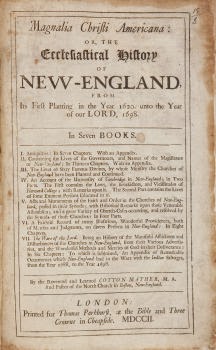
Mather's magnum opus - Magnalia Christi
Americana - a history of New England


Ultimately Cotton Mather found his place in his world primarily through his writing.  He was a prolific and diverse author, composing over 400 books in his lifetime on theology, politics, history and science.  Mather was one of the early colonial proponents of germ theory and inoculations – scientific ideas that many clergy members opposed.  He was also was an early proponent of hybridization in agriculture. 


It is indicative of Mather’s wide influence beyond the Puritan world that he developed a relationship with a young BENJAMIN FRANKLIN.  Historian John  Lienhard describes an incident that occurred on a visit by Franklin to Cotton Mather’s home.  Franklin had been an apprentice to one of Mather’s scientific critics, but found the preacher/scientist’s writing intriguing.   After a chat Franklin turned to leave. 

 “As Franklin was leaving, Mather shouted at him, "Stoop, stoop!"  Too late! Franklin struck his head on the low doorjamb, and Mather intoned: "You are young, and have the world before you; stoop as you go through it, and you will miss many hard thumps." Franklin did not miss the point. Later he said, "I often think of [Mather's words] when I see pride mortified, and misfortunes brought upon people by their carrying their heads too high."
 
Cotton Mather has no relation to, and should not be confused with:
 
Marshall Mathers, aka Eminen


Jerry Mathers, aka The Beaver

 
Unfortunately, to the larger world Cotton Mather is most well known in connection to the Salem Witch Trials of 1692.  This tragic incident in America history is one of the most difficult for those in the modern world to comprehend.  What seems to be true is that something happened among the people of the village of Salem that was unexplainable to the minds of 17th century New Englanders.  It is also clear that a superstitious populace and an ad hoc trial system sent innocent people to their deaths.  Mather is linked to the sad affair in two ways.  His political influence had helped place the key players in the trial in their governing roles before the events started happening.  And, though he was not directly involved in the proceedings, his commentary in writing on what was going on at the time seems to have validated the charges and outcomes of the trials. 
 
Two very different depictions of the witch trials:


In all honesty, as I’ve read several accounts of the trials, it is difficult to know what to make of Cotton Mather’s role.  He certainly had the influence to turn the trials in a different direction had he wanted to.  But his writings are somewhat contradictory. He seems to advocate on the one hand a careful and thorough investigation of what was taking place and argued against the death penalty, but provided the theological basis for the possibility of spiritual forces at work in the town upon which the convictions rested. 
 
Cotton Mather's home on Hanover Street in Boston


Cotton Mather’s later years were filled with difficulty.  He had two wives die and his third wife reportedly went mad.  He fathered fifteen children but only two outlived him.  His role in the Salem trials brought criticism throughout his remaining life.  And the zeal for godliness and a fully Christian community that characterized the early years of American Puritanism began to give way to liberalism and division even as Mather sought to preach and lead and write against the secular tide.  However, as he aged he turned more and more to intercessory prayer, particularly prayer for revival of true Christian religion in new England.  On February 13, 1728, one day after his 65th birthday, Cotton Mather died in Boston.  His prayer for revival had not been answered in his lifetime, but within a few short years the Great Awakening  broke out – a revival of the very Puritan theology that Mather and his family had worked so hard to promote in the New World. 


All of the Mathers are buried in a single simple tomb at historic Copp’s Hill Burial Ground.  It is a beautiful spot overlooking Old North Church in one direction and Breed’s and Bunker Hills across the Charles River in the other.  (I found this short amateur Video somebody made on a tour as they walked through the cemetery on the way to the Mather site).  Copp’s Hill is the second oldest burial ground in Boston and is directly on the Freedom Trail.    As my picture (and the video) show, the tomb was in a sad state of disrepair.  I would love to see more made of this historic family and their contribution to the religious and cultural heritage of our country.  But the sad irony is that the Mathers and the Reformed theology they espoused are both disregarded in the New England that owes so much of its character to their formative influence. 


Maybe Cotton Mather's own words offer a helpful perspective on posterity:
 
 
“History is the story of events, with praise or blame.”


Your blogger at the Mathers tomb


Cotton Mather has had a couple of interesting pop culture incarnations since he passed from the scene.  Marvel comics created a villain for the Spider Man series in the seventies called Cotton Mather.  Here’s a description:
 
 
Powers/Abilities: Mather powers' origin are unknown (probably they were granted to him by the Dark Rider). Mather could sense and find magic beings, project his voice (or thoughts) at very long distances, control and command other's will by touching them or hitting them with the fire shot from his wooden cross. Mather seemed stronger than a normal human. Mather used a wooden cross as weapon. The cross could shoot a "purifying" fire, not burning things, but strong enough to hurt Spider-Man and drive the Vision off. The fire also allowed him to control Scarlet Witch's will.


A little more image-friendly tribute came in the form of the 1990’s Austin, Texas band Cotton Mather.  The alt/pop band became an underground sensation particularly in England with the release of their self-produced album Kontiki.   It was re-released in 2012.  Here’s promo for it. 


Saturday, November 24, 2012

Jean Jacques Rousseau

Paris, France - Visited June 2009


Jean Jacques Rousseau was born June 1712 in Geneva, Switzerland.  His mother died shortly after his birth, and his father left home to avoid legal problems when he was 10. He was raised by his maternal uncle. After doing some biographical research I've decided to do this post along the theme of 'Calvinist/Not a Calvinist'.  Feel free to play along at home.


This picture has little to do with Rousseau, but its a great
shot of my beautiful wife at the Jet D'eau in Geneva
Calvinist.  Rousseau was born in Geneva, and to be in Geneva in the 18th Century meant you were a defacto Calvinist.  He spent two years boarding with a Calvinist and for a time considered whether he was called to the ministry. But he apparently had problems with doctrine of total depravity and found himself proselytized toward Catholicism. A relationship with an older woman who became his mistress complicated his late teens and early twenties, but it also introduced him to a world of ideas beyond his religious upbringing.   Hence, Not a Calvinist.


Rousseau worked a series of administrative posts through his twenties and early thirties which culminated with his arrival in Paris in 1744. During these years Rousseau fathered five children by a mistress, but had them all given up to a foundling hospital. There is no record of any of the children surviving to adulthood.  Therefore apparently Not a Calvinist (or a Catholic for that matter).


Early printing of Rousseau's
'Social Contract"
Rousseau began to engage in philosophical thinking and writing, initially focusing on music theory. He also worked on his own musical compositions, which were received well by the Paris musical establishment. But his ideas and his personality created controversy in Paris and in 1754 Rousseau returned to Geneva, requiring a reconversion (of sorts) to Calvinism to be allowed entrance to the city.  Once again A Calvinist.  However, his subsequent writing and lifestyle make it clear that his Calvinism was of his own peculiar orientation. Not being a reader of Rousseau, as near as I can tell his religious philosophy seemed to create opposition from Catholics, Protestants and Humanists. It was oppositional to Catholicism because it was anti-institutional. It was rejected by the Humanists because it avowed a view of God who was much more active and knowable than the prevailing deism of the time. Yet his rejection of original sin and other Gospel doctrines separated him from orthodox protestant Christianity.  Therefore, Not a Calvinist


Finding himself out of favor (and religiously condemned) Rousseau eventually found a patron in British philosopher David Hume, and from 1765-67 he lived in England. His mental health began to deteriorate; according to Hume, “He is plainly mad, after having long been maddish”. By 1770 Rousseau had returned to Paris, though for the remaining years of his life he was largely a recluse. His health deteriorating, Rousseau died while on a walk in July 1778. He was 66 years old. His autobiographical Confessions were published eight years after his death.  Based on them, clearly Not a Calvinist.


Jean Jacques in his furry cap stage
Final score:  Calvinist - 2; Not a Calvinist - 4. 

Historically speaking, Rousseau’s philosophy heavily influenced the leaders of the French Revolution and later, the moral/political philosophy of Immanuel Kant. I wish I could give a nice, tidy description of Rousseau’s philosophy, but I couldn’t wrap my brain around it without doing far more study than is worth it to write this blog.  An odd but short and low budget animated explanation of Rousseau's philosophy can be viewed here.  For a bit more on Rousseau's impact on philosophy, government and ethics check out this five minute overview.


Historian Kingsley Martin summarized Rousseau's influence in this way,

"In truth," Rousseau was a genius whose real influence cannot be traced with precision because it pervaded all the thought that followed him....Men will always be sharply divided about Rousseau: for he released imagination as well as sentimentalism;; he increased men’s desire for justice as well as confusing their minds , and he gave the poor hope even though the rich could make use of his arguments. In one direction at least Rousseau’s influence was a steady one: he discredited force as a basis for the State, convinced men that authority was legitimate only when founded in rational consent and that no arguments from passing expediency could justify a government in disregarding individual freedom or in failing to promote social equality


Statue of Rousseau in his birthplace of Geneva

The following brief quote seems to be a decent summary of the understanding of human nature that Rousseau built his life and philosophy upon.


“Man is born free and everywhere he is in chains.”


Rousseau's tomb in the crypt below the Pantheon in Paris


Your blogger at the Pantheon
Jean Jacques Rousseau was eventually buried with hero honors in the Pantheon in Paris. His tomb is in the underground crypt along with Victor Hugo, Alexandre Dumas, Voltaire and other French notables. I visited the Pantheon during my 25th wedding anniversary.  Jill was very kind to let me check it out and enjoyed the beautiful sunny day while watching a protest march from the steps of the Pantheon. It’s an incredible building – the French equivalent to Westminster Abbey. Well worth a stop if you’re in the City of Lights.


Saturday, August 25, 2012

William Tennent Sr.

Warminster, PA      Visited August 2012


This is the only known portrait of William
Tennent, Sr.  Kind of scary, but
probably just poorly done.


This blog tends focus on the well known and celebrated in history. But occasionally I want to include lesser known figures – either because their stories are worth telling or their contribution has been tragically overlooked. This post fits both criteria.


William Tennent Sr. is a footnote of American History – a locally prominent minister in the outlying areas of colonial Philadelphia. But his role in shaping the religious underpinnings of our national identity is profound and his story is an inspiring example of a man willing to live in obscurity for the glory of God.


William Tennent was born in Scotland in 1673 and educated into the ministry at the University of Edinburgh. He brought his family to the American Colonies in 1718 and settled in Pennsylvania, eventually taking the pastorate of a small rural Presbyterian church in Warminster, PA. Tennent self-educated all four of his sons, each of whom professed an early desire to enter the ministry. At that time ministers desiring ordination were required to receive formal education either in Europe or at one of the New England colleges. Neither option was possible for the Tennents. William also became concerned about the theological liberalism that characterized the formally trained ministers in his area. So he decided to take it upon himself to do the work. He had a small wood timber building constructed next to his home and this one room structure became his ‘Log College’.

An illustrated rendering of the Log College. It was used as a pig pen after the school
closed and then burned down later on. Nothing remains of the structure.


Tennent instructing a student
at the Log College
Through his ministerial contacts he attracted bright, serious-minded young men who wanted to be trained for Gospel ministry. From 1726 till Tennent’s death in 1746 the little building turned out small bands of Gospel preaching ministers whose impact profoundly shaped the religious and social landscape of the emerging United States. Over fifty colleges and universities across the country can trace their roots in some way back to the Tennent’s vision for educating preachers of the Gospel. The most prominent of these is Princeton University, its early leadership stocked with men whose education occurred not in the great universities but in the one room schoolhouse known as the Log College.


William Tennent’s relationship with George Whitefield played a prominent part in the Great Awakening in the Middle Atlantic Colonies. Whitefield considered Philadelphia a key base on his Colonial preaching tours. Tennant and Whitefield developed a friendship across denominational lines (Whitefield was Anglican and Tennent was Presbyterian) when Tennent went to Philadelphia in 1739 to hear Whitefield preach. Whitefield found deep kinship with the elder Tennent, whom he affectionately described as ‘that old grey haired disciple’. Whitefield twice preached in the field in front of Tennent’s church, drawing three thousand listeners one time and five thousand the next – an astounding number of people for an area that was considered virtually wilderness at the time.


Historic marker for the Log College
along Warminster Road

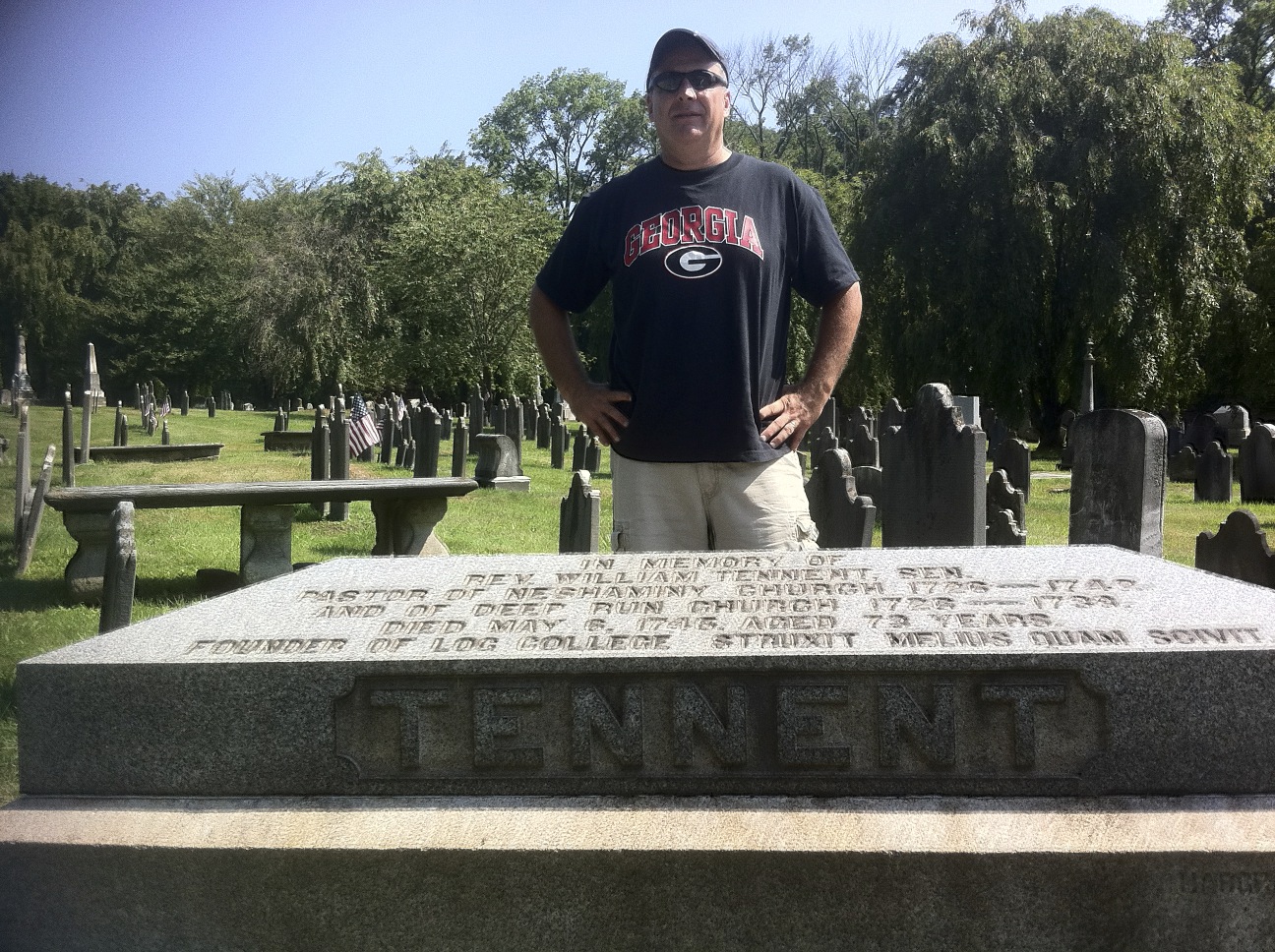
William Tennent Sr. ministered faithfully to the ripe old age of 73 in 1746. His church has remained a Gospel light in southeastern Pennsylvania until this day. All four of William Sr’s sons went into Gospel ministry. Two of them, Gilbert and William Jr became major players in the Great Awakening and will be the subjects of future posts. The elder Tennent is buried in the church cemetery of Neshaminy Presbyterian Church. On his tombstone is inscribed a most appropriate epitaph. Translated from the Latin is says,


He built better than he knew


Your Blogger at William Tennent's grave in the cemetery of
Neshaminy-Warwick Presbyterian Church.  The original
cover slab is in the church.  George Whitefield preached to
thousands on two occasions right behind where I'm standing


I had the chance to visit William Tennent’s grave with a group of friends and fellow ministers from several Sovereign Grace churches. Among the crew piling into a rented van were assorted pastors, interns, lay leaders, a church planting resident, a couple of guys headed to the next Pastors College class, a seminary student, an international Christian relief worker (my brother John) and an African pastor. Besides the Tennent sites in Warminster we also traveled to Freehold NJ to see William Jr’s church and then to Princeton Cemetery where several Log College grads (as well as Jonathan Edwards and other future blog subjects) are buried.


Our roving Great Awakening band of brothers at the Log
College Monument in Warminster, PA.


Wednesday, July 4, 2012

John Hancock

Boston, MA. Visited July 2003


John Singleton Copley Portrait


John Hancock is more than just a practitioner of great penmanship and inspiration for a full range of insurance products. He is a remarkable Founding Father whose leadership and courage played a key role in American independence.


John Hancock was born in January 1736 in the hamlet of Braintree (later Quincy), MA, also the hometown of his fellow Founding Father John Adams. His father was a well respected minister who gave his family a comfortable living. When John was seven his father died and his mother decided to send him to Boston to be raised by his wealthy merchant uncle Thomas Hancock. John graduated from Harvard College and began to work in his uncle’s shipping concern, learning the business from the ground up. In 1764 Thomas Hancock died and John inherited the entire estate including the business empire and thousands of acres of property, making him instantaneously one of the wealthiest men in the colonies.

Will Smith as 'Hancock' - not a
faithful biography

Unfortunately, John had little time to enjoy his newfound largesse. Within a month of his uncle’s death the Sugar Act was enacted, inaugurating an escalating tension between the Colonies and the Crown over ‘taxation without representation’. The tension centered in Boston. As a prominent Bostonian whose livelihood was tied to good relations to British interests, Hancock initially found himself advocating cooperation with the government. But with the Stamp Act of 1765 he began to increasingly side with the emerging patriot movement and came under the influence of the radical Samuel Adams. Through the next few years of turbulence leading up to the Boston Tea Party in 1773 Hancock’s stature as a patriot grew. His speech on the fourth anniversary of the Boston Massacre on March 5, 1774 was distributed throughout the Colonies and broadened his reputation beyond New England. Here is a quote from the speech that provides insight into Hancock as a leader and as a man.

"I have the most animating confidence that the present noble struggle for liberty will terminate gloriously for America. And let us play the man for our God, and for the cities of our God; whilst we are using the means in our power, let us humbly commit our righteous cause to the great Lord of the Universe, who loveth righteousness and hateth iniquity. And having secured the approbation of our hearts by a faithful and unwearied discharge of our duty to our country, let us joyfully leave our concerns in the hands of Him who raiseth up and pulleth down the empires and kingdoms of the world as He pleases; and with cheerful submission to His sovereign will, devoutly say, "Although the fig tree shall not blossom neither shall fruit be in the vines, the labor of the olive shall fail and the field shall yield not meat, the flock shall be cut off from the fold and there shall be no herd in the stalls, yet we will rejoice in the Lord, we will joy in the God of our salvation." [Habakkuk 3:17-18]"


John Hancock played an indirect but key role in one of the touchstone events of the Revolutionary War. Having been chosen as a delegate to the Continental Congress, Hancock (along with Samuel Adams) attempted to make his way to Philadelphia while avoiding arrest by the British. The pair slipped into Lexington in mid April 1775 just as the British were commencing their march toward Concord. Patriots in Boston sent messengers to Lexington to warn the two leaders, one of whom was Paul Revere. Due to his Revere’s ride and the ‘shot heard round the world’, Hancock and Adams escaped capture and made it to Philadelphia. Due to his standing and proven fidelity to the Colonial cause John Hancock was elected president of the Congress. It was during his time in the Congress that Hancock married, though both children from the marriage did not survive to adulthood.


John Trumbull's famous depiction of the signing 
of the Declaration of Indepedence 


For a stirring depiction of the
ratification vote see this scene 
from the acclaimed 'John Adams'
While he served tirelessly as president of the Congress throughout most of the Revolutionary War, it is John Hancock’s signature on the Declaration of Independence that may best define his leadership. Legend has it that Hancock wrote his signature with large flourish because he wanted to make sure the King could read it without spectacles, but the truth is at the same time more mundane and heroic than the legend. In reality, as president of the Congress, Hancock’s signature was the only signature on the original Declaration, as was customary at the time. That’s why his signature is so prominent. In effect, John Hancock was the first Founding Father to officially declare his rebellion against Britain. Within a month all of the delegates signed the document as a show of unity in the cause of liberty.


Hancock Statue in Boston

Prior to the end of the war Hancock requested a leave of absence from the Continental Congress in order to lead troops into battle, though he lacked any command experience. His one opportunity in the war led to a minor defeat and an apparent reality check on his military ambitions. With the end of the war the wildly popular Hancock was elected first governor of the Commonwealth of Massachusetts. With the exception of a short hiatus, it was an office he would hold for the final 13 years of his life.


The blogger at Hancock's grave -
inappropriately attired in an OBX
tee shirt
John Hancock died in October 1793 at the age of 56 after a long period of increasingly debilitating illness. He was afforded a lavish funeral and was laid to rest in the Old Granary Burial Ground at the edge of Boston Common. The relatively small cemetery is often mistaken as the church cemetery for Park Street Church, but in fact the church was built nearly a hundred years after the establishment of the cemetery. Old Granary is a must stop on the Freedom Trail. In addition to John Hancock it also holds Samuel Adams, Paul Revere and other notables from Boston’s Colonial past. I’ve been there a couple of times, most recently with my brother John and friend Bauer Evans.


An illustration of Park Street Church and the Old Granary
Burial Ground