Showing posts with label 2000's. Show all posts

Monday, March 30, 2015

Johnny Cash

Nashville, TN   Visited April 2013


A post about the legendary Johnny Cash.  There is a personal dimension to this one because it turns out that I am related to the Man in Black.  Details at the bottom of this post.  But first the story.


In doing research on Johnny Cash I realized there is no way I could capture his extraordinary life and art in a blog.  So I thought I’d do something different.  I’ll give some basic bio, then I’ll:  
  • Give 10 remarkable/curious/notable facts about the man.
  • Give five insightful quotes from or about him.  
  • Give my list of the top five Johnny Cash songs.


Little J. R. Cash

Johnny Cash was born February 26, 1932 in Kingsland, Arkansas.  The Cash family were poor cotton farmers but had a strong Pentecostal background.  The death of Cash’s older brother in a sawmill accident at 15 had a profound effect on him and was often referenced in his story for the rest of his life. Cash served in the air force in Germany in 1950-54.  Upon his discharge in 1954 he married his first wife Vivian.  They had four daughters.  Was signed initially signed  to Sun Records by Sam Phillips in 1955.  His first major hit was I Walk the Line. He rose to prominence as both a country music star and popular music personality in the 1960's.  Serious drug and alcohol addiction nearly destroyed him in the mid sixties, and his erratic behavior cost him his first marriage.   


Cash married June Carter in 1968 and they had one son.  From 1969-71 Johnny hosted The Johnny Cash Show on CBS, where he brought performers from the country and pop words together to perform.  While his own recording career would taper down over the next quarter century, Cash collaborated with artists across the pop music performance in making music and live performances.  Johnny quit performing due to a degenerative nerve disorder in 1997.  He and June lived as revered elders in country music until June’s death in May 2003 after 35 years of marriage.  Johnny died less than four months later on September 12, 2003.  He was 71.   The Cash’s are buried at Hendersonville Memorial Gardens in Hendersonville, TN, just outside Nashville. 


Johnny Cash is the only performer elected to the Country Music, Rock and Roll and Songwriters Halls of Fame.


Ten Remarkable/Curious/Notable Facts about Johnny Cash – In Chronological Order.

#1  Johnny Cash’s legal name at birth was J. R. Cash – no names, just initials.  He took the name Johnny when he enlisted in the army. 

#2  Cash was taught the guitar by his mother who wanted him to sing gospel music.  He began writing and singing (in a high tenor voice) when he was twelve.

#3  Cash was the first military radio operator to decode the news that Joseph Stalin had died. 

#4  On December 4, 1956 Johnny Cash was in the Sun Studio in Nashville.  In a nearby recording room Carl Perkins was recording a song backed on piano by Jerry Lee Lewis.  A young singer named Elvis Presley dropped in and the four commenced a jam session of mostly gospel tunes that was later released as “The Million Dollar Quartet”.

The Million Dollar Quartet - from left to right,
Lewis, Perkins, Presley, Cash
    #5  Johnny Cash began wearing his signature black suit early in his career primarily because it was easier to keep looking clean on tour.  He became known as ‘the Undertaker’ because of it.


    Early J.C with signature guitar pose

    #6  In 1965 Cash was driving his truck in Los Padres National Forest in California when it caught fire.   The fire destroyed over 500 acres of forest on two mountains.  When asked why it happened, Cash told a judge, "I didn't do it, my truck did, and it's dead, so you can't question it."

    #7  Johnny Cash first performed at the Grand Ole Opry in 1956.  In 1965 he was banned from the Opry because he smashed all the flood lights with a microphone stand.  He was reinstated a few years later.  

     #8  In 1983 Johnny Cash played a heroic sheriff in the movie, Murder in Coweta County.  Andy Griffith played the bad guy in the movie. 


    C+ Christian with Billy Graham


    #9  In 1986 Cash published his only novel – a fictionalized account of the Apostle Paul entitled “Man in White”.  The idea came out of his religious conversion; a born again experience that had a lasting effect on his life even as he struggled to live consistently as a follower of Christ.   He once said he graded himself a  C+ as a Christian.


    #10  Johnny Cash recorded sixty songs in the last four months of his life.
      He finished the final track for his last album a week before he died.


    Johnny and June Carter Cash


    Five quotes by or about the Man in Black


    “The beast in me is caged by frail and fragile bars.” - Johnny Cash


    “How well I have learned that there is no fence to sit on between heaven and hell. There is a deep, wide gulf, a chasm, and in that chasm is no place for any man” - Johnny Cash


    Dylan and Cash - they were neighbors in Woodstock, NY
    in the mid 1960's
    "He is what the land and country is all about, the heart and soul of it personified and what it means to be here; and he said it all in plain English.  Listen to him, and he will always bring you to your senses.” - Bob Dylan

    “He showed me his house, his ranch, his zoo (seriously, he had a zoo in Nashville), his faith, his musicianship.  He was more than wise. In a garden full of weeds — the oak tree.” - Bono


    "Johnny, I want to send out a big thanks for the inspiration.  You took the social consciousness from folk music, the gravity and humor from country music, and the rebellion out of rock and roll, and taught all us young guys that not only was it all right to tear up all those lines and boundaries, but it was important." – Bruce Springsteen


    Five favorite songs. 

    The Highwaymen (L to R):  Willie Nelson, Waylon
    Jennings, Johnny Cash, Kris Kristofferson - 1980s
    #5 A Boy Named Sue:  What was initially as a novelty song released on the B side of the San Quentin single, it became his only top ten pop hit.  This is one of the first records I bought and I had memorized the entire song when I was about 9 years old.  I still know more of it than I should.  Here’s the live version from Cash's San Quentin Prison show in 1969.


    # 4 Folsom Prison Blues: The Man in Black’s signature prison song – raw lyrical approach almost unique in country music history – or pop and rock history for that matter.  Cash said that he wrote the song while in the military in 1953.  Here’s a live performance from the early 70's.   

    #3 Hurt:  Cash’s version of Trent Reznor’s song was recorded just months before he died in 2003.  Cash got permission from Reznor to change some of the lyrics to make it more consistent with his Christian faith.  The video of the song (pardon the quality) is considered one of the greatest music video’s of all time.  


    #2 I Walk the Line:  Johnny wrote this song early in his career and it became the song for which he is best known.  Here is a version recorded on the Tex Ritter Show when Johnny was 23 – pre ‘Man in Black’ days.  


    #1 Ring of Fire:  My favorite Cash song – a beautiful melody and haunting lyrics.  Johnny came up with the idea of using the mariachi horns.  This easy-going acoustic version with Willie Nelson is really nice. 


    Johnny's gear at the Country Music
    Hall of Fame


    One bonus video worth checking out is Cash's performance of Big River at his induction into the Rock and Roll Hall of Fame in 1992.  Among the cast of thousands onstage for the jam are Keith Richards, John Fogarty, Steve Cropper, the Edge and Carlos Santana - a testament to the wide reaching impact of the art of Johnny Cash.  


    From Johnny Cash's last performance - July 5, 2003 - Hiltons, VA


    I visited the Cash family plot in Hendersonville, outside of Nashville with my friend Ian.  It’s a typical municipal cemetery and the plot area is near the parking lot – a remarkably normal location for such a famous artist.  


    Your blogger with Johnny's plaque at the Country
    Music Hall of Fame in Nashville


    At the Cash family plot
    Cash's self-selected inscription captures his
    conflicted desire to glorify God and the
    relentless grace that never let him go.


    Family connection:  My brother John has been doing research on our family history and discovered in the process that our family and Cash’s family were related in north Georgia in the 1800’s. Cash developed an interest in his family history later in life and therefore a good deal of information is available about that part of our family. 

    Officially, we are fifth cousins twice removed. We share common Scottish roots. Our ancestors immigrated to Salem, Massachusetts in the 1670’s,settling in Virginia not long afterward. Later sons fought in the revolutionary war and as a result received land grants in north east Georgia in the late 1700’s. Johnny Cash’s great-grand-father moved from Georgia to Arkansas in 1850 where Johnny was born about 82 years later. Unfortunately for us the Cash line took most of the the musical talent and the nice full head of hair. 

    John has created a beautiful web site about the family history based on his research.  At one time you could find a Farmer or a Fricks or a Cash almost anywhere in North Georgia.  But times change and people move on.  Its good to have a family heritage collected and accessible for future generations.  You can check the site out at Leatherwood Creek.


    Monday, February 16, 2015

    Ronald Reagan

    Simi Valley, California     Visited June 2013


    I try to do a post on a president every February to commemorate President’s Day.  This is one I’ve been looking forward to – Ronald Reagan, the Great Communicator.  The two terms of President Ronald Reagan happen to represent the polar opposites of my journey across the political spectrum.  We’ll get to that; but first here is my take on our 40th president.


    Ronald Wilson Reagan was born February 6, 1911, the second of two boys, in Tampico Illinois.  His upbringing was classic Middle America – his father was a salesman who moved the family around the mid-west following jobs, his mom a devoted mother and devout influence in his life.  Little Ron got the nickname “Dutch” early in life because he was a little on the chubby side and sported a ‘Dutch boy’ haircut.  


    In high school Dutch Reagan engaged in sports and acting and worked as a lifeguard in the summer.  He enrolled at Eureka College, a small Christian liberal arts school in Illinois where some of the themes that characterized his future life began to emerge.  Reagan played sports, did theater, involved himself in student government, and graduated with a degree in economics and sociology. 


    Wedding of Ronald Reagan and
    Jane Wyman
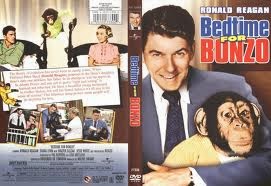
    Coming out of college Ronald Reagan fell immediately into the world of entertainment.  He took a job broadcasting Iowa Hawkeye football games and parlayed his natural talent into other sports broadcasting gigs.  Most notably he developed an ability to do play by play for Chicago Cubs broadcasts using just the wire feed.  On a road trip with the Cubs to the west coast in 1937 the 26-year-old Reagan did a screen test, which led to a seven-year movie studio contract.  It was also in 1937 that he joined the army reserve.  By the start of World War II in 1941 Ronald Reagan had already appeared in 30 Hollywood films and was voted one of the top younger actors in Hollywood.  He married his first wife, actress Jane Wyman, in 1938.   Reagan was called to active duty in 1942, but due to poor eyesight remained stateside for the duration of the war, producing training and fundraising films for the US Army film division. 


    Dutch's low point in the movies


    Maybe his greatest film moment -
    the indelible 
     'Win one for the Gipper'


    Studio photo
    Following the war Reagan resumed his Hollywood career.  While he continued to make pictures through the 1950’s, Ronald Reagan never made it to the first ranks of Hollywood leading men.  He did become influential in the film business, however, serving multiple terms as president of the Screen Actors Guild.  His leadership in the SAG included the black list period of the early fifties and Reagan’s staunch anti-communism caught him somewhat reluctantly into the hunt for communists in Hollywood.  It was apparently these political impulses that helped bring about the end of his first marriage in 1949.  Later that year Reagan met another actress, Nancy Davis, and in 1952 they were married.  Reagan had two children with Jane Wyman and two children with Nancy.  Nancy would become his lifelong love and their marriage was by all accounts close and affectionate through the end of his days. 


    Ronald Reagan and Nancy Davis in the film
    that brought them together

    Governor Reagan

    Ronald Reagan began his political career as a democrat, campaigning for Harry Truman in 1948.  But his increasingly conservative views led him to support Eisenhower and later Richard Nixon in their presidential campaigns.  He eventually switched to the Republican Party in 1962.   In 1964 he emerged onto the national scene as political player with his rousing A Time for Choosing speech  in support of Barry Goldwater at the Republican presidential convention.  He won the governorship of California in 1966 on a promise to ‘send the welfare bums back to work and clean up the mess at Berkley’ (in reference to perpetual student demonstrations).  His confrontations with protesters and use of force to quell dissent made him something of a polarizing figure, but he was popular enough to win a second term in 1970. 


    In 1976 Reagan launched his first serious challenge for the White House, losing a primary battle to incumbent Gerald Ford.  But in 1980 he was able seize on the Iran hostage crisis and hard economic times to mount a winning campaign against the vulnerable Jimmy Carter.  On January 20, 1981 Ronald Reagan was sworn in as the 40th president of the United States, bringing in what he had termed during the campaign as ‘morning in America’.  At 69 years old he was the oldest candidate ever elected to a first term as president.  The first days of his presidency were eventful.  On Inauguration Day the Iran Hostages were released after 444 days of captivity.  On March 30, 1981 he was the target of an assassination attempt by a mentally ill John Hinckley, Jr.  Reagan was seriously wounded and near death when arrived at the hospital but was stabilized and later recovered completely, becoming the only president in US history to survive a wound from an assassination attempt.  


    A list of keywords from Reagan’s first term would be:  Air Traffic Controllers Strike, Supply-side economics (also called trickle-down economics or Reaganomics), Sandra Day O’Connor, the Strategic Defense Initiative (SDI or, derisively, ‘star wars’), the Beirut bombing, Operation Urgent Fury (Grenada), and the War on Drugs. 


    The Teflon President and the Iron Lady in a golf cart

    Ronald Reagan was re-elected in a historic landslide victory over Walter Mondale 1984.  Notable keywords from his second term include the Libya bombings, the Space Shuttle Challenger disaster, the Gorbachev Summits, William Rehnquist and Antonin Scalia, Tip O’Neill and the Iran-Contra Affair, Perestroika, and the Iron Lady.


    In retrospect, his presidency has been called the Reagan Revolution – a remaking of conservatism as a dynamic political force in domestic affairs and a hard line stance against communism that set the stage for the dramatic and largely peaceful fall of the Soviet communist system.  Critics claim that Reagan was an out of touch leader and his revolution set back civil rights and led to the economic bust of the early 1990’s.  But there is no disagreement on the reality that Ronald Reagan was the most culturally and globally influential president in the second half of the 20th Century.  Among the various presidential ranking polls Ronald Reagan averages out to around 15th on lists of the greatest presidents. 


    Ronald Reagan became know as 'The Great Communicator' because of his remarkable ability to connect with the American people and capture the sense of a moment in a way that raised the stature of the presidency.  Consider these examples:


    • As the Representative of the American People - January 28, 1986 - addressing the nation following the Challenger Disaster


    After leaving the White House the Reagans moved to California and the former president enjoyed a number of years of growing stature as the elder statesman of the conservative movement.  In 1994 at the age of 83 Reagan publicly disclosed that he had Alzheimer’s disease.  His frank and personal letter to the nation about his illness raised awareness of the disease and represented the last and most poignant public act of ‘the Great Communicator’. 

    I have recently been told that I am one of the millions of Americans who will be afflicted with Alzheimer's Disease... At the moment I feel just fine. I intend to live the remainder of the years God gives me on this earth doing the things I have always done... I now begin the journey that will lead me into the sunset of my life. I know that for America there will always be a bright dawn ahead. Thank you, my friends. May God always bless you.


    Five Presidents

    Though he stayed active for as long as he could, Reagan lived for ten years in a gradually degenerating condition, his last few years with only Nancy as a regular presence in his life.  On June 5, 2004 at his home in Bel Air, CA President Ronald Reagan passed into history.  Over 100,000 paid their respects as he lay in state in the US Capitol Rotunda.  He was buried in a site overlooking the Simi Valley just outside of the Reagan Presidential Library. 

    Mikhail Gorbachev at Ronald Reagan's State Funeral

    My son Grant and I had the chance to visit the Reagan Museum and his tomb at the Reagan Library.  The Museum is a wonderfully conceptualized and beautifully designed walk through the Reagan era, and includes the full Air Force One in a special public hangar.  It is well worth a visit if you’re in California. 


    My son Grant and Air Force One at the Reagan Library and Museum


    I never saw Ronald Reagan in person.  But earlier I mentioned how the Reagan presidency highlights my radical change in political orientation.  Here’s the story. 

    When I was a senior in college Ronald Reagan was running in his first presidential campaign against Jimmy Carter.  It was during my phase Marxist years and, as a leftist political science major, I should have been all wrapped up in the political moment.  But it was college and there were so many distractions…  Anyway, I woke up one morning and realized that it was Election Day.  So I borrowed a car and went into town to vote.  When I got there they asked me if I was registered.  I said, ‘No, I’m an American citizen’.  When it dawned on me that I had missed that one little necessary detail of American civics I decided to go back to school to await the outcome as a non-combatant in the political process.  One thing I did know is that it was unthinkable that Ronald Reagan – a conservative! – could win the election.  Which of course is just what happened.  Of course, by the time they called the results we had been at a party anticipating a great democratic win.  Incensed by defeat, aghast at the project of four years of Republican rule and a little looser in judgment than we should have been, my friend Rick and I found some spray paint begging to be put into political use.  There was a wall located just outside the student union building that everyone had to pass in order to go to class.  We felt it needed a paint job.  With words.  So we (as artfully as possible under the circumstances) covered the wall with the immortal words:  “Ronald Reagan – an actor playing his greatest role”.  Ok, it wasn’t Berkley in the Sixties.   But it seemed radical at the time.  


    Your blogger with Dutch at the Reagan Museum and Library
    A year later I had renounced the Marxism I had embraced in college and, in the next election – my first as a bona fide registered voter – I cast my vote for the Gipper.  I’ve been a fan ever since.


    Monday, January 27, 2014

    Wilson Pickett


    Louisville, Kentucky.  Visited October 2011


    There are times when I step back and consider this odd hobby I have and think, ‘are you nuts?’  This post comes from one of those times.  I didn’t think a visit to the final resting place of my favorite soul singer would be very unnerving.  I was wrong. 


    Wilson Pickett was born March 18, 1941 in Prattville, Alabama.  He was the fourth of eleven children.  In his later years, Pickett described a family home terrorized by an abusive mother.  Barely into his teenage years, he moved to Detroit to live with his father.  At age 14 in Detroit, Pickett began to sing in a Gospel choir.  Four years later, like many black singers of his era, he moved from traditional Gospel singing to a more commercial rhythm and blues style, which was the precursor of soul music.  In 1961, he signed on with a relatively successful R&B group, the Falconers. 


    Early performances
    Pickett began to distinguish himself as a soloist and a songwriter and within couple of years was trying to make it as a solo act.  He connected with Atlantic Records and pitched a song he co-wrote called “If You Need Me”.  However, without Pickett’s knowledge the song was passed along to the already established Solomon Burke.  It became one of Burke’s greatest hits and a soul standard.  However, on the strength of this song and his singing talent, Wilson Pickett signed with Atlantic in 1964. 
     

    It was a recording session at the legendary Stax Recording Studio in Memphis that really launched Wilson Pickett’s career.  Jamming with the studio band (the equally legendary “MG”s including Duck Dunn and Steve Cropper); the singer and musicians came up with the groove and structure of “In the Midnight Hour”.  It became Pickett’s first No. 1 R&B single and peaked at 21 on the pop charts.  Over time, the song has settled into the pantheon of all-time hits. 

    Wilson Pickett backed up by Jimi Hendrix
     

    Most of Wilson Pickett’s best-known hits come from his Stax period. It was also at Stax that he acquired his nickname “Wicked Pickett”.  While the record company most likely gave it to him for marketing purposes, the name unfortunately tended to describe the singer’s private life.  Throughout his career, Wilson Pickett battled alcohol and drug issues and was arrested at various times for violence-related offenses.  As a performer, however, he became one of the iconic soul/R&B artists of his era.  While most of his success came in the Sixties and early Seventies, Pickett create music and perform into the early 2000s, with several minor hits even in his later years.
     

    Pickett and Duane Allman
     

    While he has not attained the status of some of his contemporaries who worked with Motown, Wilson Pickett’s signature vocal style, dynamic live performances and ability to write many of his biggest hits have given him a prominent place in pop music history.  In 1999, he was inducted into the Rock and Roll Hall of Fame.  He continued to perform through the 90’s, retiring due to health concerns in 2004.  Wilson Pickett died of a heart attack in Reston, Virginia on January 19, 2006.  He was laid to rest in a mausoleum at Evergreen Cemetery in Louisville, KY, where he had family in the later part of his life.
    
     
    Seventies Pickett


    Here are my five favorite Wilson Pickett songs

    FIVE:   Hey Jude (1968)’.  It’s pretty gutsy to record an iconic Beatles song but Pickett pulls of a nice R&B groove.  And the song has great guitar work by Duane Allman. 

    FOUR:  Land of 1000 Dances (1966).  This is just full tilt Sixties dance/party music.  The clip here is a great G concert version from a 1971 show in Africa. 

    THREE:  Mustang Sally (1966).  Killer groove.  This live version shows you how good R&B can flat out rock. 

    TWO:   Don't Let the Green Grass Fool You (1971).  Pickett recorded this at TSOP in Philly.  It was the first Wilson Pickett song I remember ever hearing.  Caught a sixth grader’s attention and stayed with him.

    ONE:   In the Midnight Hour (1965).  Wicked Pickett’s signature song.  An all-time great.  He did a duet of this song at his Rock & Roll Hall of Fame induction with Bruce Springsteen.  The version here is done with the Blues Brothers Band in the 1980’s featuring Duck Dunn and Steve Cropper.  Also check out this revved up take from a live seventies vintage show . 
     
     
    Wicked Pickett and the Boss at the 1999
    Rock and Roll Hall of Fame Concert
     
    So where does the freak-out come in?  Here’s my story.  It was a bleak stormy afternoon.  I was driving in a rental car back to the Louisville airport but had about 20 minutes to kill.  I knew Wilson Pickett was buried at a cemetery near the airport so I thought I’d make a quick stop.  I asked a woman at the Evergreen Cemetery office where I could find Wilson Pickett and she said, ‘he’s in the mausoleum at the other end of the cemetery.  It’s open, just go in and look for his crypt at the back of the mausoleum’.  So, he’s at the back of a mausoleum at the back of a cemetery.  Not good.  I get in my car and drive – a long way.  I finally arrive at this big square building made entirely of marble and glass.  There is no one else anywhere around.
     

    Mausoleum at Evergreen Cemetery.  My experience wasn't
    quite so bucolic


    I open the glass door and step inside a large atrium like area with stacks of wall crypts two stories high all around.  The wind and rain are howling outside.  I begin to walk to the back of the room.  Every noise, every step, echoes off the marble walls.  Glass windows and doors shudder against the wind.  I find Pickett’s vault and start to take a picture, but realize I don’t have any way to verify I was there.  I take off my Phillies cap to put it near (as my blog protocol requires) but there’s no place to lay it.  A few feet away there is an ornate podium.  I go over to get it and realize its solid bronze.  So, of course, I have to drag it across the room.  The ear-burning screech as I pull the podium across a marble floor reverberates around the room like a ghoulish shriek.  At this point, I am verifiably freaking out.  I take a picture, maybe three (to get good light).  I grab my hat and literally run back through the mausoleum and out the door.  I jump in my car and, punching the gas, careen out of the cemetery as fast as I can drive.  Once I made it back to the main road, I stopped and took a breath.  I think my first one since I started the mad dash from the mausoleum. 

    Was it worth it?  Maybe. Maybe not.