Showing posts with label 1900's. Show all posts

Sunday, January 25, 2015

Audie Murphy

Arlington, VA    Visited April 1972

This post is dedicated to the most decorated U.S. soldier in World War II.  Today, January 25, 2015 is the 70th Anniversary of Audie Murphy’s one-man war on German infantry and tanks that resulted in him receiving the Medal of Honor.  His story is about as classic an American tale as you can imagine. 


Murphy Kids in rural Texas - Audie Leon on right
Audie Leon Murphy was born June 20, 1925 in Kingston, TX; the seventh of twelve children of a poor sharecropper who deserted the family when Audie was five.  Young Audie quit school in the fifth grade to work and support the family.  When his mother died around his 16th birthday, Murphy tried to earn enough money to keep the family together but several of his younger siblings were sent to an orphanage. 


With the attack on Pearl Harbor in 1941 the sixteen year-old teen joined thousands of other patriotically-minded young men and tried to enlist to fight in the war effort.  He was rejected by all the military branches because he was both too young and too small – 5’5” and 110 pounds of teenage zeal.  Just after his 17th birthday Audie’s sister falsified an affidavit on his age and Murphy was accepted into the U.S. Army.  Upon completion of infantry training, Private Audie Murphy was sent to Morocco with the 3rd Infantry Division in February 1943. 


Audie Murphy 2nd from left, Co B, 1st Battalion, 
15th Regiment, 3rd Infantry Division, US Army

Murphy saw significant combat as part of the Sicily campaign and, in September 1943, was in action during the invasion of the Italian mainland at Salerno.  Murphy’s bravery and natural leadership on the battlefield led to promotion to full staff sergeant in January 1944, less than a year after his initial deployment as a buck private.  After the fall of Italy in June 1944, Sergeant Murphy participated in the invasion of Southern France, along the way receiving a number of combat citations for performance in battle.  He received the first of three Purple Hearts for a heel wound in September 1944, and then a second Purple Heart about six weeks later after being shot in the hip by a sniper (he shot the sniper between the eyes). 

In the cold of northeastern France during January 1945, recently promoted Lt. Murphy was leading a patrol in enemy occupied territory.  It was here, on January 25, 1945, that Audie Murphy displayed the ‘conspicuous gallantry and outstanding courage above and beyond the call of duty in action against the enemy, in keeping with the highest traditions of the U.S. Army’ that resulted in him being awarded the Medal of Honor.  The following is a description of his actions taken directly from his Medal of Honor citation. 

2d Lt. Murphy commanded Company B, which was attacked by 6 tanks and waves of infantry. 2d Lt. Murphy ordered his men to withdraw to prepared positions in a woods, while he remained forward at his command post and continued to give fire directions to the artillery by telephone. Behind him, to his right, 1 of our tank destroyers received a direct hit and began to burn. Its crew withdrew to the woods. 2d Lt. Murphy continued to direct artillery fire which killed large numbers of the advancing enemy infantry. With the enemy tanks abreast of his position, 2d Lt. Murphy climbed on the burning tank destroyer, which was in danger of blowing up at any moment, and employed its .50 caliber machine gun against the enemy. He was alone and exposed to German fire from 3 sides, but his deadly fire killed dozens of Germans and caused their infantry attack to waver. The enemy tanks, losing infantry support, began to fall back. For an hour the Germans tried every available weapon to eliminate 2d Lt. Murphy, but he continued to hold his position and wiped out a squad which was trying to creep up unnoticed on his right flank. Germans reached as close as 10 yards, only to be mowed down by his fire. He received a leg wound, but ignored it and continued the single-handed fight until his ammunition was exhausted. He then made his way to his company, refused medical attention, and organized the company in a counterattack which forced the Germans to withdraw. His directing of artillery fire wiped out many of the enemy; he killed or wounded about 50. 2d Lt. Murphy's indomitable courage and his refusal to give an inch of ground saved his company from possible encirclement and destruction, and enabled it to hold the woods which had been the enemy's objective.”

When asked why he would take such bold and dangerous actions, Murphy responded, “They were killing my friends”. 


Medal of Honor award Ceremony


Following his recovery from his wounds now 1st Lt Murphy was reassigned to a staff position for the remainder of his tour of duty.  He received his discharge papers after VE Day on September 21, 1945.  During his less than three years as a combat soldier Audie Murphy had received every possible combat decoration possible in the army – some of them multiple times. 


A justifiable war hero, Audie Murphy returned to civilian life with no real idea of what to do next.  With the help of writer David McClure, Murphy published his wartime autobiography To Hell and Back in 1949.   Through the help of James Cagney, the untrained and under-educated veteran began a career in Hollywood, first appearing in bit rolls in minor films.  In 1951 Murphy got his first starring role in a major motion picture in John Huston’s adaptation of Stephen Crane’s (who had been a soldier in the Civil War) The Red Badge of Courage.  In 1955 Audie Murphy had the unusual opportunity to play himself in a film version of his own autobiography.  Two Hell and Back was a huge hit, the biggest grossing film in the history of Universal Studios until Jaws in 1975.  All total, Audie Murphy appeared in forty films and a consistent stream of television shows over a twenty year Hollywood career.  He also had some success as a songwriter, with his song lyrics being recorded by the likes of Dean Martin, Eddy Arnold and Harry Nilsson.  Here's a short video of his 1955 appearance on What's My Line?


Audie Murphy as 'the Youth' in "Red Badge of Courage"


A recreated scene of Audie Murphy's Medal of Honor heroics in "To Hell and Back.
See the footage of Audie playing Audie Here

In perhaps one of his most heroic acts, in the 1960’s Audie Murphy began to speak about his struggles with what is now known as Post Traumatic Stress Disorder.  He had been plagued by PTSD (then called combat fatigue or shell shock) ever since the war.  It was a taboo subject for the military, and to have the most decorated member of the Greatest Generation openly talk about his personal trials was unprecedented.  Murphy became an advocate for Korean and Vietnam veterans who struggled with PTSD, raising awareness and funding for improved medical treatment.  Murphy described his struggles, which included nightmares, insomnia, rage, gambling problems and a short addiction to sleeping pills this way,

"War is like a giant pack rat, it takes something from you and it leaves something behind in its stead. It burned me out in some ways so that now I feel like an old man but still sometimes act like a dumb kid. It made me grow up too fast. You live so much on nervous excitement that when it is over you fall apart."


Odd publicity shot of Murphy and family on the Peter Pan ride at
Disneyland
Audie Murphy in 1961


Audie Murphy in the late 1960's


On May 28, 1971 Audie Murphy was on a small plane with five other passengers that  crashed in zero visibility weather in the Blue Ridge Mountains near Roanoke, VA.  There were no survivors.  He was 45 years old.  Audie Murphy was buried with full honors at Arlington National Cemetery.  Per his request his tombstone was not decorated with the customary gold emblem of a Medal of Honor winner.  He was just a soldier.  And that was enough. 

Marker where Audie Murphy's plane went
down near Roanoke, VA


Your blogger at Arlington November 2012


I first saw Audie Murphy's grave on the same seventh grade school patrol trip that first   took me to JFK’s grave.  I try to see it every time I go back.  


"People are very quick to ridicule others for showing fear. But we rarely know the secret springboards behind human action. The man who shows great fear today may be tomorrow's hero. Who are we to judge?"   
Audie Murphy


Monday, November 17, 2014

Benjamin O. Davis, Jr.

Arlington, VA              Visited November 2012


I’ve decided to dedicate November in respect to war veterans by doing posts from Arlington National Cemetery.  This month its an honor to post on Benjamin O. Davis, Jr., commander of the Tuskegee Airmen in World War II and the first black four star general officer in the United States Military. 

Benjamin Oliver Davis, Jr. was born December 18, 1912 in Washington, DC.  His father, Benjamin O. Davis, Sr. was a career military officer who had been one of the original Buffalo Soldiers in Utah during the late 1800’s.  In 1940 Benjamin Davis, Sr. attained the rank of brigadier general, becoming the first black general in the history of the U. S. Military.  


Young Benjamin’s mother died when he was four years old and he was raised largely by his grandparents as his father was stationed in various locations stateside and abroad.  When he was 13 in 1926 he went for a ride in a barnstorming plane and his craving to fly was hooked. 

After high school he attended University of Chicago but was nominated for admission to the U.S. Military Academy, where he enrolled in 1932.  Sadly, Davis’ time at West Point was characterized by racial bigotry and intentional shunning by the otherwise all-white student body.  The isolated cadet refused to be intimidated by four years of daily racism and graduated in 1936, 35th in a class of nearly 300.  Davis later recalled his experience,

Cadet Davis

''Living as a prisoner in solitary confinement for four years had not destroyed my personality, nor poisoned my attitude toward other people,'' he would write in recalling his thoughts upon graduating. ''I had even managed to keep a sense of humor about the situation; when my father told me of my many supporters, the many people who were pulling for me, I said, 'It's a pity none of them were at West Point.' ''

Cadet Davis’ character was ultimately vindicated by the Academy; as demonstrated by the inscription under his picture in the Academy yearbook,


“The courage, tenacity, and intelligence with which he conquered a problem incomparably more difficult than plebe year won for him the sincere admiration of his classmates, and his single-minded determination to continue in his chosen career cannot fail to inspire respect wherever fortune may lead him.


Soldiers' Davis Sr. and Jr.
When Davis graduated he became just the second black line officer in the army – the only other being his father, Benjamin Sr.   Denied access to flight school because of his race, Benjamin Jr. was assigned to an infantry unit stationed in Fort Benning, GA.  Looking for a way to avoid having a black officer command white enlisted men, the army moved Davis to a training position at the all-black Tuskegee Institute in Alabama. 


Following the entry of the U.S. into World War II, President Roosevelt (bowing to political pressure) authorized the formation of the first black aviation wing - the 332 Fighter Group -  at Tuskegee Institute.  Davis signed up and became one of the first ‘Tuskegee Airmen”.  He was the first black man to solo a U.S. warplane.  In July 1942 Benjamin Davis was promoted to lieutenant colonel and placed in command over the first all black fighter squadron.  The 99th Pursuit Squadron saw extensive combat action in the North African and Sicily Campaigns. 


Having returned stateside to train another unit, Colonel Davis found himself having to defend the performance of the 99th against charges that it had performed poorly and therefore needed to be decommissioned.  One white commander testified that, “the Negro type has not the proper reflexes to make a first-class fighter pilot.”  An inquiry revealed that the black fighter pilots had actually performed well in comparison with the rest of the army air force.  About this time the issue of  the competence of black pilots in combat was settled by the remarkable success of the Tuskegee Airmen in the skies over the invasion of Anzio.  Overall, the “Red Tails” (as they were known) flew over 15,000 sorties, shooting down 111 Luftwaffe planes.  Davis himself received the Silver Star and the Distinguished Flying Cross for his personal performance as a fighter pilot. 


From the movie Red Tails a great scene - "We Fight!".  From the same movie a short air combat scene.


Here is a stirring short video of General Benjamin O. Davis, Jr personally decorating his son and other Tuskegee Airmen.


At the end of the war Benjamin O. Davis, Jr. was tasked with drawing up a racial integration plan for the newly formed U. S. Air Force – which became the first service to branch to fully integrate.  His career for next two decades advanced up the command ranks in the Pentagon and in overseas assignments.  During the Korean conflict Davis took command of another fighter wing, flying the new F-86 Sabre jet fighters.  In 1960 Benjamin O. Davis, Jr. was permanently promoted to brigadier general.  In 1965, while serving as chief of staff of the U.N. Air command in South Korea, Davis received his final active duty promotion; attaining the rank of lieutenant general (3 stars).  General Davis, Jr. retired from the service in 1970.


Formal portraits of the General in mid and late career.


Following his military service General Davis served in a variety of public roles, most prominently as a deputy secretary in the Department of Transportation, where he developed the U. S. Air Marshall aviation safety force. 


In 1998 President Clinton promoted Davis to the rank of full Four Star General – again, the first black man ever to attain the top rank in the U. S. Military.  By this time General Davis had begun to battle the effects of Alzheimer’s disease.  He lost his wife of 66 years in early 2002, and a few months later Benjamin O. Davis, Jr passed away at the age of 89 – July 4, 2002.  He was buried with full honors at Arlington National Cemetery.   President Clinton’s words at Benjamin O. Davis’ ultimate promotion well describe his remarkable career and service to his country.


"General Davis is here today as living proof that a person can overcome adversity and discrimination, achieve great things, turn skeptics into believers; and through example and perseverance, one person can bring truly extraordinary change"


Fellow 'Red Tails' honoring their fallen commander at the burial ceremony
for Benjamin O. Davis, Jr at Arlington Cemetery.


I saw General Davis' grave on a visit to the cemetery with my son and nephew on the way to Georgia for Thanksgiving.


Monday, October 27, 2014

Joe DiMaggio

Colma,  California       Visited June 2013


October is baseball month at the blog and this month we feature the great New York Yankee centerfielder Joe DiMaggio.  For a brief slideshow on DiMaggio set to Les Brown's 1991 recording "Joltin Joe DiMaggio" go here.


Joe DiMaggio was born to a first generation Italian immigrant family that settled in the San Francisco area at the turn of the century.  Giuseppe Paulo DiMaggio was born November 25, 1914, the eighth of nine children.  His father was a fisherman who wanted his sons to follow in the family trade.  But Joseph hated everything about fishing and constantly fought his father’s insistence on join him on the boat.  Joseph instead turned to baseball, where he showed early promise, even though he had no real drive to excel at the game.  His first significant professional experience occurred October 1, 1932 with the San Francisco Seals, the Pacific Coast League team on which his brother Vince played.    

In his first full year in the PCL, 1932, Joe demonstrated his rare ability to sustain a hot streak by hitting in 61 straight games.  It remains the longest one season hitting streak in baseball history.  The experience of the feat marked DiMaggio, who later said,

"Baseball didn't really get into my blood until I knocked off that hitting streak. Getting a daily hit became more important to me than eating, drinking or sleeping."


Young DiMaggio and Lou Gehrig, 1937


The Yankees purchased Joe DiMaggio’s contract from the Seals and he debuted in pinstripes May 3, 1936 in Yankee Stadium.   As rookie in his first game he batted third, just ahead of legendary Yankee Lou Gehrig.  The Yankees had not been to the World Series in four years, but with DiMaggio joining the team in ‘36 they began a streak of four straight World Series championships. 


From 1936 to 1942 DiMaggio emerged as a major league star, developing a reputation as a dynamic hitter and stellar center fielder.  He was given the nickname ‘Yankee Clipper’ by the New York PA announcer, who compared his speed and range in the field to a new Pan Am airliner.   What set DiMaggio apart wasn’t just his hitting but a sense of class that seemed to emanate from him.  Teammate Phil Rizzuto once said,

"There was an aura about him. He walked like no one else walked. He did things so easily. He was immaculate in everything he did. Kings of State wanted to meet him and be with him. He carried himself so well. He could fit in any place in the world."

DiMaggio’s style gave him open pass in Hollywood, where he met his first wife, actress Dorothy Arnold.  They were married in 1949, but the marriage dissolved early on and they were divorced in 1943. 

The Splendid Splinter Ted Williams with the Yankee Clipper Joe DiMaggio


Joe DiMaggio went into the 1941 season at the top of is game.  On May 15, 1941 he went hitless.   However, it would be another 56 games before he would again take an o-fer.  DiMaggio’s 56 game hitting streak is often considered the greatest hitting feat ever accomplished in the major leagues.  It is remarkable beyond the shear number.   During the streak, Joltin Joe batted .408 with 15 homers, 55 RBIs.  He struck out only five times.  Twenty-two of the games in the streak were multi-hit games.  He even got a hit in the All Star game, which was not included in the streak.  Perhaps what is most remarkable is that, when the streak ended on July 17, he hit safely in the next 16 straight games, giving him a hit in 72 out of 73 straight games.  DiMaggio won his second MVP award after the season, besting rival Ted Williams and his .406 batting average.


Joe DiMaggio in his army uniform with his son, Joe, Jr.  
Following the 1942 season the Yankee Clipper enlisted in the army and was attached to a morale unit.  His wartime responsibilities centered on playing baseball for army teams in exhibitions to raise money and support for the war effort.  DiMaggio didn’t see any combat action and was discharged in 1945.  For a time during the war his parents were classified as enemy aliens.   


Joltin Joe’ returned to Major League Baseball for the 1946 season.  His performance picked up where it had left off after three years in the war effort, with DiMaggio winning his third MVP in 1947.  Also in 1947 the Yankees and Red Sox reached a tentative agreement to trade Joe DiMaggio for Ted Williams, but the Yankees backed out when the Red Sox also insisted on the inclusion of Yogi Berra. 


By 1951 DiMaggio’s numbers were down and he realized his career was done.  He told a Sporting News reporter,

I feel like I have reached the stage where I can no longer produce for my club, my manager, and my teammates. I had a poor year, but even if I had hit .350, this would have been my last year. I was full of aches and pains and it had become a chore for me to play. When baseball is no longer fun, it's no longer a game, and so, I've played my last game.


All total, The Yankee Clipper played 13 seasons over a 16-year career.  He led the Yankees to ten World Series appearances and nine championships and was an all star in every year of his career.  Maybe the most remarkable stat for his career is that he had nearly as many home runs (361) as he did strikeouts (369).  DiMaggio was elected to the Hall of Fame in 1955.


DiMaggio's stuff at the Hall of Fame


Your blogger doing a selfie in front of the DiMaggio HoF plaque - July 2014


If anything, Joe DiMaggio’s celebrity status grew following his retirement.  The chief reason for his notoriety was his romance, marriage and life long devotion to Marilyn Monroe.  The retired player and the budding star met shortly after DiMaggio’s retirement in 1952.  Eighteen months after meeting they married at the San Francisco City Hall.  It seems that DiMaggio was smitten by the actress, who was 12 years younger, while Monroe drew to DiMaggio almost as a father figure.  A divorce in 1954 did not end a life long tumultuous relationship.  But at the time of her death there was no one in her life besides DiMaggio that Marilyn Monroe trusted.  DiMaggio provided for her burial and had flowers sent to her grave on a weekly basis till his own death.


DiMaggio and Monroe in a rare private photo shoot


Joe DiMaggio’s post baseball career was long, varied and largely successful.  He traded on his fame but also managed himself.  Here he is as a mystery guest on What's My Line in 1955.     His last official involvement in baseball occurred as a coach for the Oakland Athletics in 1968-69.   Its a testament to his enduring celebrity that more than a decade after his retirement he was still a well known enough figure to be universally recognized as the spokesman for Mr. Coffee.    While becoming increasingly guarded of his private life as he aged, DiMaggio’s natural grace and cool made him a natural ambassador for the game of baseball, a role he was happy to fulfill.  


1969 baseball card


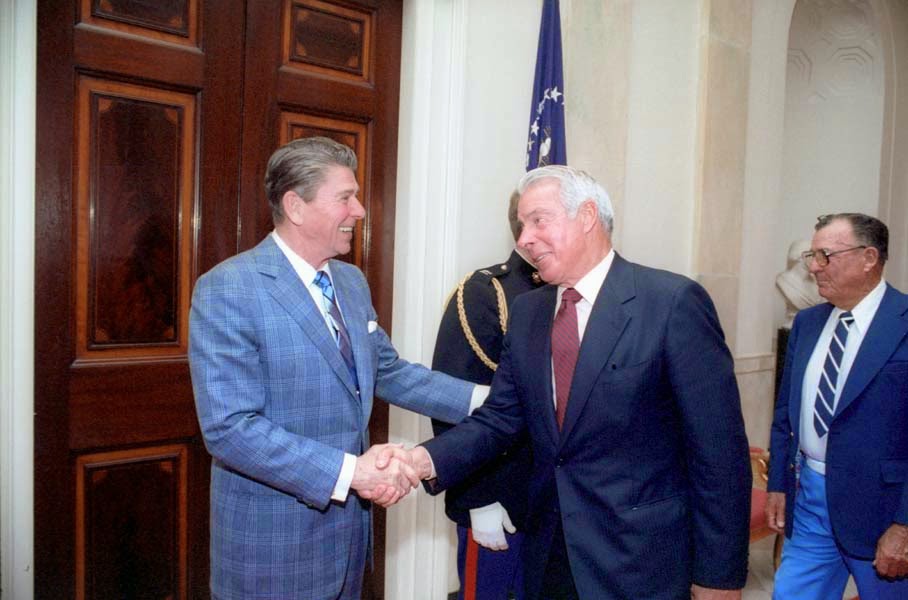
The Gipper and the Yankee Clipper in the mid-80's.  
As a final example of his enduring celebrity status check out this 1991 clip from "Seinfeld" where Kramer waxes eloquent on how Joe DiMaggio dunks his donuts.    

Joe DiMaggio finished out his life in Hollywood, Florida and died at his home from lung cancer on March 8, 1999.  He is buried near his hometown at Holy Cross Catholic Cemetery in Colma, California.  My son Grant and I visited the Yankee Clipper’s grave on our epic trip to California in June 2013.  He's buried at Holy Cross Catholic Cemetery in Colma, California, just south of San Francisco.

Your blogger at Joltin' Joe's grave - plenty of memorabilia left in tribute