Showing posts with label Theologians. Show all posts

Wednesday, September 25, 2013

Cotton Mather

Boston, MA   Visited April 2006


I’ve wrestled with this post.  Cotton Mather is difficult to capture in simple biography.  Pious but strident, thoroughly puritan but enamored with the age of science, a man committed to broad Christian charity but defined most significantly in one of the darkest expressions of religious superstition in American history.  A fascinating and perplexing subject for the blog. 


Cotton Mather was born in Boston February 1663.  Both of his grandfathers – John Cotton and Richard Mather - were pastors who emigrated from a religiously hostile England and became prominent first generation New England Puritans.  Cotton Mather’s father, Increase Mather was perhaps the dean of Puritan pastors in the late 1600’s, as well as a president of Harvard College.  To be a prominent pastor was not simply a religious standing.  In Puritan New England governing and pastoring were closely aligned.  So Cotton Mather grew up with some big shoes to fill. 


Increase Mather - Cotton's Pappy

 
Early in life he showed both significant academic gifting and a heart to serve God.  He entered Harvard College at age twelve, graduated at fifteen  and, after further divinity study was ordained to the ministry at age eighteen.  Mather took his first pastoral position serving under his Father at the North Church – the figurative center of Puritanism in New England.  It seems that the younger Mather’s relationship with his father/superior was at times contentious, as Cotton Mather sought to distinguish himself and his ministry from the shadow of his illustrious father. 
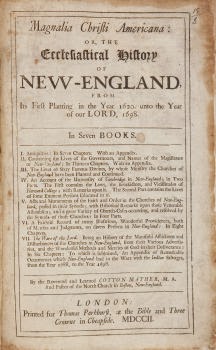


Mather's magnum opus - Magnalia Christi
Americana - a history of New England


Ultimately Cotton Mather found his place in his world primarily through his writing.  He was a prolific and diverse author, composing over 400 books in his lifetime on theology, politics, history and science.  Mather was one of the early colonial proponents of germ theory and inoculations – scientific ideas that many clergy members opposed.  He was also was an early proponent of hybridization in agriculture. 


It is indicative of Mather’s wide influence beyond the Puritan world that he developed a relationship with a young BENJAMIN FRANKLIN.  Historian John  Lienhard describes an incident that occurred on a visit by Franklin to Cotton Mather’s home.  Franklin had been an apprentice to one of Mather’s scientific critics, but found the preacher/scientist’s writing intriguing.   After a chat Franklin turned to leave. 

 “As Franklin was leaving, Mather shouted at him, "Stoop, stoop!"  Too late! Franklin struck his head on the low doorjamb, and Mather intoned: "You are young, and have the world before you; stoop as you go through it, and you will miss many hard thumps." Franklin did not miss the point. Later he said, "I often think of [Mather's words] when I see pride mortified, and misfortunes brought upon people by their carrying their heads too high."
 
Cotton Mather has no relation to, and should not be confused with:
 
Marshall Mathers, aka Eminen


Jerry Mathers, aka The Beaver

 
Unfortunately, to the larger world Cotton Mather is most well known in connection to the Salem Witch Trials of 1692.  This tragic incident in America history is one of the most difficult for those in the modern world to comprehend.  What seems to be true is that something happened among the people of the village of Salem that was unexplainable to the minds of 17th century New Englanders.  It is also clear that a superstitious populace and an ad hoc trial system sent innocent people to their deaths.  Mather is linked to the sad affair in two ways.  His political influence had helped place the key players in the trial in their governing roles before the events started happening.  And, though he was not directly involved in the proceedings, his commentary in writing on what was going on at the time seems to have validated the charges and outcomes of the trials. 
 
Two very different depictions of the witch trials:


In all honesty, as I’ve read several accounts of the trials, it is difficult to know what to make of Cotton Mather’s role.  He certainly had the influence to turn the trials in a different direction had he wanted to.  But his writings are somewhat contradictory. He seems to advocate on the one hand a careful and thorough investigation of what was taking place and argued against the death penalty, but provided the theological basis for the possibility of spiritual forces at work in the town upon which the convictions rested. 
 
Cotton Mather's home on Hanover Street in Boston


Cotton Mather’s later years were filled with difficulty.  He had two wives die and his third wife reportedly went mad.  He fathered fifteen children but only two outlived him.  His role in the Salem trials brought criticism throughout his remaining life.  And the zeal for godliness and a fully Christian community that characterized the early years of American Puritanism began to give way to liberalism and division even as Mather sought to preach and lead and write against the secular tide.  However, as he aged he turned more and more to intercessory prayer, particularly prayer for revival of true Christian religion in new England.  On February 13, 1728, one day after his 65th birthday, Cotton Mather died in Boston.  His prayer for revival had not been answered in his lifetime, but within a few short years the Great Awakening  broke out – a revival of the very Puritan theology that Mather and his family had worked so hard to promote in the New World. 


All of the Mathers are buried in a single simple tomb at historic Copp’s Hill Burial Ground.  It is a beautiful spot overlooking Old North Church in one direction and Breed’s and Bunker Hills across the Charles River in the other.  (I found this short amateur Video somebody made on a tour as they walked through the cemetery on the way to the Mather site).  Copp’s Hill is the second oldest burial ground in Boston and is directly on the Freedom Trail.    As my picture (and the video) show, the tomb was in a sad state of disrepair.  I would love to see more made of this historic family and their contribution to the religious and cultural heritage of our country.  But the sad irony is that the Mathers and the Reformed theology they espoused are both disregarded in the New England that owes so much of its character to their formative influence. 


Maybe Cotton Mather's own words offer a helpful perspective on posterity:
 
 
“History is the story of events, with praise or blame.”


Your blogger at the Mathers tomb


Cotton Mather has had a couple of interesting pop culture incarnations since he passed from the scene.  Marvel comics created a villain for the Spider Man series in the seventies called Cotton Mather.  Here’s a description:
 
 
Powers/Abilities: Mather powers' origin are unknown (probably they were granted to him by the Dark Rider). Mather could sense and find magic beings, project his voice (or thoughts) at very long distances, control and command other's will by touching them or hitting them with the fire shot from his wooden cross. Mather seemed stronger than a normal human. Mather used a wooden cross as weapon. The cross could shoot a "purifying" fire, not burning things, but strong enough to hurt Spider-Man and drive the Vision off. The fire also allowed him to control Scarlet Witch's will.


A little more image-friendly tribute came in the form of the 1990’s Austin, Texas band Cotton Mather.  The alt/pop band became an underground sensation particularly in England with the release of their self-produced album Kontiki.   It was re-released in 2012.  Here’s promo for it. 


Monday, April 15, 2013

Benjamin B. Warfield

Princeton, New Jersey Visited August 2012


Benjamin Breckenridge Warfield was one of the titans of the Reformed faith at the turn of the 20th Century. In an age where the very essence of Biblical Christianity was being undermined by theological liberalism, "The Lion of Princeton" stood for the historic orthodox doctrine of the Faith with a towering intellect and prodigious commitment to written theological argument.


The young Warfield circa 1864


Benjamin Warfield was born in 1851 in Lexington, Kentucky into the aristocratic Breckenridge clan. Warfield’s maternal grandfather was a professor of theology who was a staunch supporter of the Union cause in the Civil War. His uncle, John Breckenridge was Vice President in the Buchanan administration and became a well regarded general in the Confederate army. Warfield himself was a Unionist committed to the civil rights of African Americans throughout his life. Benjamin was raised in a thoroughly Reformed home and professed saving faith in Christ at sixteen, but did not appear to have much interest in the ministry or theological pursuits early in life.


Warfield attended Princeton College where he excelled in the sciences. Upon graduation he sought to continue study in Europe. It was in Europe that B. B. Warfield "realized the paramount claims of God and religion upon him", and accepted God’s call to preach the Gospel – to the utter surprise of all who knew him. He came back to the United States and enrolled at Princeton Seminary, graduating in 1876.  He was ordained to the ministry in the Presbyterian Church.


The year 1876 was pivotal in Warfield’s life beyond his ordination. In August of that year he married Anne Kinkead. They traveled in Europe for their honeymoon. Hiking in the mountains, they encountered a severe thunderstorm. A lighting strike nearby physically and emotionally traumatized Anne. The effect of this event was to have a lifelong impact on the Warfields. Anne returned to the U.S. in an invalid state and became a virtual recluse for the rest of her life. This tragedy at the beginning of his marriage became the defining reality for B. B. Warfield. For the rest of his life the care of his wife was his highest priority. He left pulpit ministry early for seminary professorship where he could arrange his schedule around her care. From this point on he never traveled or spent more than a couple of hours away from Anne. With the death of the legendary A. A. Hodge, B. B. Warfield returned to his alma mater in 1886 where he took up a life-long professorship in systematic theology.


Providentially, it was a combination of Warfield’s energetic intellectual gifts and his devotion to his wife which led to a ministry of singular significance in the cause of the Gospel. Not noted for his preaching skills, B. B. Warfield devoted himself to writing and publishing theological works that rival Luther and Calvin in scope and volume. It was the self imposed limits on travel and extra-curricular activity that allowed him to give his time to the study and composition of this work. Warfield’s theological output was devoted to articulating classic Reformed theology in an age of modernist thought and liberal attacks on the inerrancy and authority of Scripture. His writings remain remarkably accessible and compelling today. With contemporaries Abraham Kuyper and Herman Bavinck, B. B. Warfield carried the Reformed theology of Calvin, Edwards and Hodge through the modernist movement and sent it into the 20th Century era with compelling intellectual force.


Warfield in his study

Recent Warfield biographer Fred Zaspel was inteviewed by Justin Taylor from the Gospel Coalition on what he learned about Warfield the man.    

This is one of things that attracted me to Warfield—more than most any other I’d read he understands Christianity “whole” and finds Christ crucified at the very center. He sees both the forest and the trees and understands all as pointing to this redemptive center. And for Warfield personally this was no merely academic discovery, but he is himself marked by a keen sense of utter dependence upon Christ, and his own heart beat hot for his glorious Redeemer.


Anne Warfield died in 1915, and B. B. Warfield continued on in his ministry for six more years. They never had any children. Warfield worked hard till the very end. He suffered a minor stroke Christmas Eve, 1920.  Then on a walk across campus in February 1921 he suffered a heart attack from which he would not recover. Benjamin Breckinridge Warfield died on February 16, 1921 ending a 33 year career of scholarship at Princeton Seminary. In a sad irony, Warfield, Bavinck and Kuyper all passed into glory within nine months of each other.


Your blogger with Warfield


Map of Old Princeton Cemetery


Benjamin B. Warfield is buried in Old Princeton Cemetery. It’s actually a bit challenging to find his grave since it is not in the Edwards/Hodge section. I've been there several times, most recently with a group of pastors, theology students and missionaries on a one day tour of Great Awakening sites.  We ended our tour at Princeton Cemetery. 

Tour dudes with the Warfields - Anne Warfield to the left


Here’s a wonderful quote from Warfield that captures the clear Gospel centeredness of all his work.

Our faith itself, though it be the bond of our union with Christ through which we receive all His blessings, is not our saviour. We have but one Saviour; and that one Saviour is Jesus Christ our Lord. Nothing that we are and nothing that we can do enters in the slightest measure into the ground of our acceptance with God. Jesus did it all.

Thursday, March 29, 2012

The Oxford Martyrs

Oxford, England.  Visited November 1997


This entry is dedicated to the Oxford Martyrs, Hugh Latimer and Nicholas Ridley (Thomas Cranmer, who is also included in the group, will be treated as a separate post). These first generation Anglican leaders were burned at the stake for their commitment to the Protestant Reformation.


Hugh Latimer

Hugh Latimer (born c.1487) was a churchman who rose to the position of chaplain to protestant King Edward VI. Latimer was educated at Cambridge and was initially a vocal opponent against the new reformation ideas coming from Europe to England. But somewhere in his time in Cambridge he encountered Thomas Bilney, whose biblical arguments convinced Latimer of the soundness of the protestant view of the faith. Latimer soon fell in with the first generation of English Reformers in Cambridge including Tyndale, Coverdale, Bilney and Cranmer. It is properly said that the English Reformation began in the fellowship among this group that occurred at the White Horse Inn in Cambridge.

The blogger standing at the former site of the
White Horse Inn in Cambridge in 1997.  A plaque referencing
the Inn is nearby.


Latimer preaching to Edward VI
 During the religiously turbulent reign of Henry VIII Latimer rose to the rank of Bishop, but at least once found himself in trouble with the King over his reformed theology.  Under the more fully protestant reign of Edward VI, Latimer became a key advisor to the boy king. With Edward’s death at 15 in 1553 and the ultimate ascension to the throne by the Catholic Mary I, Hugh Latimer found himself now branded a protestant heretic and was arrested.


Nicholas Ridley

Nicholas Ridley (born c. 1500) was also Cambridge-educated and ascended up the ecclesiastical ladder under Archbishop of Canterbury Thomas Cranmer, who was seeking to fill the church with protestant minded clergymen. Ridley, a moderate reformer, rose to the influential position of Bishop of London. However, he also was caught up in the turmoil following the death of Edward, particularly through his support of the ill-fated attempt to establish protestant Lady Jane Grey on the throne. With Mary’s ascension Ridley was arrested as a heretic.


Latimer, Ridley and Cranmer were tried as heretics and enemies to the throne in Oxford. The main issues of dispute were the papacy and the protestant denial of transubstantiation in the mass. After a short, politically rigged trial all three were convicted and sentenced to death. Cranmer recanted (for a time) but Ridley and Latimer were burned at the stake October 16, 1555.

Martyrdom of Latimer and Ridley

The martyrdom of Ridley and Latimer has been famously described in Foxe’s Book of Martyrs. It is said with some authority that as the flames burned around the two men, the elder Latimer turned to Ridley to encourage him, declaring,

"Be of good comfort, Master Ridley, and play the man; we shall this day light such a candle, by God's grace, in England, as I trust shall never be put out."

The spot where the Martyrs were burned is in the middle of a street in Oxford, marked with a tile cross. Nearby is the Martyrs Memorial, commemorating the event and the Reformation it ignited in Great Britain. There is no burial place recorded for the remains of the Martyrs.


Marker where the martyrdom of Ridley and Latimer
took place in Oxford


Marker near the site of martyrdom in Oxford.  I never
saw this when I was there - my friend Aaron Mayfield
gave me his picture


My brother John and I visited Oxford when he was on retreat from the mission field in November 1997.


The blogger on a cold November day 1997at the
Martyrs Memorial in Oxford


Sunday, January 2, 2011

John Calvin

Geneva Switzerland – Visited May 2007


Portrait of John Calvin by Titian


I thought I’d start off 2011 with a personal hero – John Calvin – the generally acknowledged father of the Reformed Christian tradition. Calvin was born July 10, 1509 in Noyon, France. His vocational direction was the opposite of his theological predecessor, Martin Luther. Luther was intended by his father to be a lawyer, but instead committed himself to the priesthood. Calvin was intended by his father for the priesthood but wound up pursuing the law. As a young man John Calvin came under the influence of the humanistic Renaissance thinking of his time. His vocational desire was (really to the end of his life) to live the life of a scholar and writer. But God’s plans worked out in him not in the contemplative world of the university, but in the turbulent and at times dangerous world of pastoral ministry in a divided city.

Calvin's Pulpit at St. Pierre - Geneva
Calvin experienced an ‘unexpected conversion’ around age 24, which led him slowly but convincingly away from humanism to a Biblical worldview. He found himself numbered with the heretics in a France hostile to the Reformation and eventually found his way to the city of Geneva, Switzerland. His intent was to find a place to study and write. But the spiritual leader of the city, William Farel, persuaded Calvin to stay in Geneva and pastor the church. So in 1536 John Calvin began his pastorate – only to be rudely interrupted eighteen months later when he was kicked out of the city by a government unhappy with his efforts. While he was exiled in Strasbourg, the scholar in him found expression, and the man found a wife. However, in his absence Geneva went down the tank and the city pleaded for Calvin to return. So in 1541 John Calvin resumed his pastoral ministry in Geneva, where he remained the rest of his life.


Statue of Calvin at the Reformation
Wall in Geneva
The church in Geneva was notable because of its overlapping influence and jurisdiction in the affairs of the city. It was the goal to make Geneva a Protestant city where church and state existed in cooperative promotion of Gospel truth and life. And to an extent under Calvin that was achieved. John Knox, the Scottish Reformer who fled to Geneva to avoid persecution, called Calvin’s Geneva ‘the most perfect school of Christ’. And as experiment in Christian government it was a remarkable endeavor. But the experiment was not without challenges in the form of continual controversies over doctrine and practice and, sadly the persecution of Anabaptist believers whose practices and doctrine raised suspicion about their participation as citizens in the city.


My wife Jill doing her killer Calvin imitation


In the center of it all was the tirelessly prolific John Calvin. Over the course of a quarter century in ministry Calvin preached an average of five times per week. In addition, he wrote commentaries on nearly every book of the Bible, numerous other theological works and ministry letters that total eleven volumes. And this does not include his magnum opus, what we know as the Institutes of the Christian Religion, which Calvin first published in 1536 and continued to expand and revise until 1559. It is Calvin’s prodigious theological outworking of Reformed theology that is ultimately his greatest legacy.


Calvin’s life and ministry ended in 1564 with him, predictably, hard at work writing and pastoring his people. Upon hearing of his death, Pope Pious IV, his greatest enemy, reluctantly had to admire, ‘If I had such servants my dominion would extend from sea to sea’. Reflecting on his imminent departure Calvin feared that he might be venerated and therefore requested to be buried in an unmarked grave in the city cemetery.  However…. If you go to Geneva to the city cemetery you will find a grave that has been marked for generations as the final resting place of the Great Reformer. Who’s to say it isn’t. 


With my brother John at the reputed final resting place of J.C.


For some great thoughts from John Piper on Calvin's legacy check out What's intriguing about John Calvin.  My favorite John Calvin quote, from the beginning of the Institutes.


Calvin as we've come to know and love him

“Our Wisdom, in so far as it ought to be deemed true and solid wisdom, consists almost entirely of two parts: the knowledge of God and ourselves...it is evident that man never attains to a true self-knowledge until he has previously contemplated the face of God, and come down after such contemplation to look into himself”

Friday, October 29, 2010

A. W. Tozer

Akron, Ohio. Visited October 2008


A. W. Tozer is one of the most influential Christian writers of the 20th Century. And he occupies a significant place in my life as a follower of Christ.

Aiden Wilson Tozer was born on a small farm in western Pennsylvania in April 1897. His family moved to Akron, Ohio when he was 15. Tozer went to work for the Goodyear Rubber Company as a teenager. It was on his way home from work one day that he heard a street preacher proclaim, ‘If you don’t know how to be saved…. just call on God’. Provoked in his soul, Tozer climbed into the attic of his house, where he did indeed call on God and received the gift of salvation.


While relatively little is known about Tozer’s early Christian experience, he appears to have been gifted with a robust spiritual intellect from the beginning. In 1919, at the age of 22, A. W. Tozer received his first call to the ministry from a small Christian Missionary Alliance church in West Virginia. He spent his entire ministerial career in three churches, most prominently at Southside Alliance Church in Chicago. While possessing a renowned preaching gift, Tozer’s greatest contribution to the cause of Christ is undoubtedly his theological writing. Books such as The Pursuit of God and The Knowledge of the Holy are Twentieth Century spiritual classics, bringing significant theological reflection with clarity and depth to the average believer. His 44 year ministry ended with his sudden passing by heart attack while pastoring a church in Toronto. Tozer's family decided to lay him to rest in Ellet Cemetery, a small church cemetery in Akron. The epitaph on his tombstone is a simple description of his life and ministry – “A. W. Tozer – A Man of God.”


Visited Tozer with my friend Jason Reyes.  We got there when it was almost dark and stumbled around looking for it almost in vain.  Tozer is the top attraction in Akron in my mind.  The other two are the Blimp hangar and LeBron James' house - in that order


A. W. Tozer will always occupy a place of formative significance in my personal Christian experience. As a new believer in 1981 the first two Christian books I was given were C. S. Lewis’ Mere Christianity and a selection of Tozer’s writings entitled The Best of A. W. Tozer: Fifty-two Favorite Chapters, compiled by Warren Wiersbe. I came to Christ from an intellectually convinced atheism. These two books tag teamed me in my spiritual infancy. Lewis wrestled down my intellectual pride and skepticism against simple belief in the Savior. But it was Tozer who got in my face with glory ultimatums – who was I going to live for and what was I going to do with the few short moments I have on earth. It is to A. W. Tozer that I have returned time and again over the years when my theological closet needed to be reorganized and my namby-pamby Christian vision needs a slap in the back of the head.

I don’t know if it’s possible to have a favorite A. W. Tozer quote – his writing is almost entirely worth quoting. But here are some that remind me of what the ‘Man of God’ did for me in the early days of my journey in Christ.


“No man should desire to be happy who is not at the same time holy. He should spend his efforts in seeking to know and do the will of God, leaving to Christ the matter of how happy he should be.”

“The sovereign God wants to be loved for Himself and honored for Himself, but that is only part of what He wants. The other part is that He wants us to know that when we have Him we have everything -- we have all the rest.”

"We can afford to follow Him to failure. Faith dares to fail. The resurrection and the judgment will demonstrate before all worlds who won and who lost. We can wait."

"Faith is the gaze of a soul upon a saving God"


Wednesday, June 16, 2010

Jonathan Edwards


Princeton, New Jersey.  Visited May 2008


I'm kicking off I See Dead People with one of my spiritual heroes - Jonathan Edwards. Edwards lived from 1703 to 1758. He was a pastor/theologian who ministered most of his life in New England. Edwards is closely associated with the Great Awakening, a wide-spread spiritual revival which occurred during his pastorate in Northampton, MA 1734-35. He wrote about the experience of revival, and wise understanding of the work of the Holy Spirit in his book A Treatise Concerning Religious Affections (common title).


The only remnant of the church in Northampton where
Jonathan Edwards served as pastor - the stone step
leading into the meeting house. 


One of the things I appreciate about JE was that he understood his weaknesses and worked against them his whole life. For example, he wasn’t what you’d call a people person, which is a problem for a guy trying to pastor a church. But he fought that tendency by opening up his home and life to others, even folks who didn’t always see things his way.  Edwards was a man who wanted to live out the faith as if God is really who He says He is.


Jonathan Edwards was named first president of the College of New Jersey (which became Princeton University) in 1758, but died that same year after contracting small pox from a small pox vaccine. His daughter, who was with him at the time also contracted the disease and died about the same time, leaving small children orphaned. Edward's wife Sarah, who was preparing to move to New Jersey at the time, came down to care for her grandchildren. Sadly, she too fell ill and died in Princeton a few months after her husband and is buried with him.


Andy and fellow JE fan John Shaw with
Edwards at Old Princeton


Edwards final known words: "Trust in God and you need not fear."


Jonathan Edwards is buried at Old Princeton Cemetery (not to be confused with Princeton Seminary), among a number of great Princeton theologians (maybe to appear here in the future). Well worth a visit.


If you want to read a great bio of Jonathan Edwards, check out George Marsden's Jonathan Edwards - A Life.  If you want a great place to start reading Edwards (not an easy task, the man was thick with ideas!) I suggest his Charity and Its Fruits, an exposition of 1 Corinthians 13. Here's a favorite quote from that book:

Church history buffs on a Great Awakening tour August 2012


Sarah Edwards plaque on the Edwards crypt


"As you have not made yourself, so you were not made for yourself. You are neither the author nor the end of your own being. Nor is it you that uphold yourself in being, or that provide for yourself, or that are dependent on yourself. There is Another that hath made you, and preserves you, and provides for you, and on whom you are dependent; and He hath made you for Himself, and for the good of your fellow creatures, and not only for yourself. He has placed before you higher and nobler ends than self, even the welfare of your fellowmen, and of society, and the interests of His kingdom; and for these you ought to labor and live, not only in time, but for eternity." (180-81)


Others blog subjects buried at Princeton Cemetery:
Benjamin B Warfield