Monday, October 8, 2012

Walter "Big Train" Johnson

Rockville, MD         Visited March 2012


Walter Johnson is considered to be one of the greatest pitchers in the early years of Major League Baseball. Nicknamed ‘the Big Train’, Johnson remains first all time in career shutouts, second all time in total wins, and in the top ten in career strikeouts, Known for a blazing fastball and gentlemanly demeanor, he is one of five original inductees to the Baseball Hall of Fame.


Walter Perry Johnson was born in 1887 on a farm in Humbolt, Kansas. His family moved to California in 1901 where his father worked in the oil industry. Johnson discovered baseball in high school and semi-pro leagues where his power arm led to great pitching success. He was signed by the Washington Nationals/Senators at the age of 19 in 1907. He pitched his first major league game August 2, 1907 against the first place Detroit Tigers. Young Detroit star Ty Cobb described his first encounter with Johnson this way.

Big Train and Georgia Peach -
could not have been more
different as players or people
"On August 2, 1907, I encountered the most threatening sight I ever saw in the ball field. He was a rookie, and we licked our lips as we warmed up for the first game of a doubleheader in Washington. Evidently, manager Pongo Joe Cantillon of the Nats had picked a rube out of the cornfields of the deepest bushes to pitch against us... He was a tall, shambling galoot of about twenty, with arms so long they hung far out of his sleeves, and with a sidearm delivery that looked unimpressive at first glance... One of the Tigers imitated a cow mooing, and we hollered at Cantillon: 'Get the pitchfork ready, Joe-- your hayseed's on his way back to the barn.'  ...The first time I faced him, I watched him take that easy windup. And then something went past me that made me flinch. The thing just hissed with danger. We couldn't touch him... every one of us knew we'd met the most powerful arm ever turned loose in a ball park."


Legendary sportswriter Grantland Rice gave Johnson the nickname ‘Big Train’, referring both to his stature (a relatively large for the time 6’1 and 200 lbs) and his fastball. While there was no technology in Johnson’s era capable of tracking pitch speed, Big Train was generally thought to have the top fastball in the game for most of his career – made even more intimidating by his ‘out of nowhere’ side-armed delivery. On his straightforward approach to pitching, Johnson would simply say, "I throw as hard as I can when I think I have to throw as hard as I can."


Walter Johnson statue at National's Park in
Washington DC - depicted with his side-
armed release
Walter Johnson’s career spanned 21 years, all with Washington, ending finally in 1927. His best year was 1913, when he went an astounding 36-7 with a 1.14 ERA and eleven shutouts – perhaps the greatest single season pitching performance in major league history. While over half of his seasons were spent on teams with losing records, he did have two trips to the World Series late in his career; in 1924 and 1925 (a loss). In 1924 the Senators beat the New York Giants in seven games. Johnson didn’t pitch well in the two games he started, losing both, but came on in relief and pitched four shutout innings to win Game Seven in extra innings.


The Big Train with President Calvin Coolidge


The Big Train retired just shy of the age of forty at the end of the 1927 season. Two years later Johnson was named manager of the Senators, a position he held for four years, all with winning records. His life was visited by tragedy in 1930 when his wife died relatively early in age. After another short stint as manager of the Cleveland Indians, Walter Johnson retired from baseball in the Washington DC area. He was elected Montgomery County, Maryland commissioner and ran unsuccessfully for congress. He died at the age of 59 in December 1946.  For a nice short video montage of Walter Johnston set to some heroic music check this out.

Walter Johnson's funeral at Washington National Cathedral


Your  blogger at the entrance to
Rockville Cemetery

Walter Johnson is buried in Rockville Cemetery (aka Union Armory Cemetery) in Rockville, MD. I had the chance to visit Johnson’s grave with my friend Andrew Kalvelage when I was teaching a class at the Sovereign Grace Ministries Pastor’s College. It’s a quaint old cemetery in a residential neighborhood. There’s nothing notable about Johnson’s grave, which meant we had to wander around the cemetery for a while before we stumbled upon it.


My buddy Andrew with Walter


Its not uncommon to see baseball's left on gravestones
 in tribute to ballplayers.  I'd love to know the story of
how this one found its way to Rockville Cemetery


To get a quirky take on the Big Train check out 'Walter Johnson' by proto-punk artist Jonathan Richman; including the fitting refrain,


“All through baseball he was loved and respected. Was there bitterness in Walter Johnson? It was never detected”


Big Train's Cooperstown plaque


Monday, September 17, 2012

Winfield Scott Hancock

Norristown, PA      Visited September 2000


Reader's note:  In doing posts on the Civil War I will include both Union and Confederate figures.  I would appeal that these posts be read as human interest stories, not as commentary on that difficult period in American history and the slavery that required such a tragic war to be fought for its eradication.

In honor of the 150th Anniversary of the Battle of Antietam (Sept. 17, 1862) this is a post on Civil War General Winfield Scott Hancock. Although Hancock would gain greatest fame as the Union Army defender of the Angle during Pickett’s Charge in the Battle of Gettysburg, his actions at Antietam would display the extraordinary courage and leadership that would define his career.


Winfield Scott Hancock was born February 1824 in Montgomery County Pennsylvania. He was named after Winfield Scott, a hero of the War of 1812 and later General of the Army prior to the Civil War. He grew up the son of a teacher and was nominated for the fledgling US Military Academy at West Point. Hancock graduated an undistinguished 18th in a class of 25 in 1844. Upon receiving his commission from West Point he was assigned to various posts in the west but eventually encountered his first combat action in the Mexican War under the command of his namesake Winfield Scott. It was during the Mexican campaign of 1847-48 that Hancock began to distinguish himself as a field commander, and also where he received the first of several battle wounds in his career.

W. S. Hancock married in 1850 and the and his wife Almira had two children; neither of which survived him. He was serving in command posts in California when the Civil War broke out in 1861. He was placed in command of an infantry brigade in the Army of the Potomac. He earned the nickname “Hancock the Superb” for his leadership in the Peninsula Campaign in May 1862.


General Hancock (seated) in the field during the Civil War


Your blogger at Bloody Lane in Antietam April 2011
By the time of the Battle of Antietam he was a division commander under Israel Richardson. At Antietam, the bloodiest one day battle of the war, Hancock found himself part of a union assault on a sunken road defended by entrenched Confederates. Just as the Union appeared to gain the decisive edge General Richardson was mortally wounded, and Hancock was pressed into emergency duty to lead the corps in the midst of the battle. Characteristically, Hancock bravely mounted his horse and rode to the front of the line rallying his troops and securing ‘Bloody Lane’ for the Union. On the basis of the action he was promoted to major general.


A beat up pick-up in the approximate location where Hancock rallied
Union troops at the Sunken Road (Bloody Lane).  Historians generally
agree that no pick-up trucks were used in battle during the Civil War. 
Though I'm sure they would have been a great help.


Hancock’s command excellence tended to place him in the center of battle. At the Battle of Fredericksburg in December 1862 his division was the main assault force on Marye’s Heights, suffering disastrous casualties in that ill-conceived attack. Hancock himself was shot in the abdomen. Nevertheless Hancock’s leadership and bravery during this battle led to his receiving a corps command. He was wounded yet again at the Battle of Chancellorsville.


Hancock statue at Gettysburg. For a stirring dramatic account of
his actions see these excerpts from the movie "Gettysburg"   

At Gettysburg General Hancock once again found himself at the center of a major attack. But this time his soldiers were secured behind the rocks on high ground and they repelled the massive Confederate assault led General George Pickett on the third day of the battle in what has become known as the High Water Mark of the Confederacy. For a third time in seven months Hancock received a severe battle wound, but he refused to be carried from the field until his position (historically known as ‘The Angle’) was secure.

  
Hancock recovered from these wounds to return to corps command and was involved in all of the significant engagements of the Army of the Potomac up through the surrender of Robert E. Lee's army at Appomattox. In the immediate aftermath of the war Hancock was once again placed at the center of the action when he was required to carry out the executions of the Lincoln assassination conspirators in 1865. It was a duty which he found emotionally difficult to carry out since it involved the execution of people who may have only had peripheral connection to the assassination plot.

Winfield Scott Hancock had one of the most distinguished post-war careers of any Civil War commander; serving over several different departments of the Army over the next 15 years. His distinguished war record and impeccable personal integrity made him a popular national figure, which led to his receiving the Democratic Party nomination for President in the election of 1880. He lost to James Garfield, also a Union general in the Civil War. Garfield's presidency was cut short by assassination just 200 days after he was inaugurated.


Campaign Poster for Hancock's
1880 presidential run

Hancock as a chicken in a political
cartoon during the 1880 campaign


Hancock’s final station was based in Governors Island, NY as head of the Army Department of the Middle Atlantic (East Coast). His last public duty was the oversight of Ulysees Grant's funeral in New York in August 1885. He died in New York in February 1886 of a skin infection at the age of 62. General Grant’s posthumous Memoirs published around the time of Hancock’s own death provide a wonderful memorial to “Hancock the Superb”.

Hancock stands the most conspicuous figure of all the general officers who did not exercise a separate command. He commanded a corps longer than any other one, and his name was never mentioned as having committed in battle a blunder for which he was responsible. He was a man of very conspicuous personal appearance.... His genial disposition made him friends, and his personal courage and his presence with his command in the thickest of the fight won for him the confidence of troops serving under him. No matter how hard the fight, the 2d corps always felt that their commander was looking after them

Winfield Scott Hancock is buried in Riverside Cemetery just outside of Norristown PA. It’s an interesting cemetery,  located at the end of a residential street in a blue collar neighborhood overlooking the Schuylkill River. Several other signficant figures from the Civil War are buried there as well.  Hancock’s mausoleum is right next to the back yards of a group of brick row homes and has been protected from vandalism by a chain link fence. I visited there with two history buff pastor/friends of mine – Bauer Evans and Arie Mangrum.

Your blogger at Hancock's grave in 2000


Saturday, August 25, 2012

William Tennent Sr.

Warminster, PA      Visited August 2012


This is the only known portrait of William
Tennent, Sr.  Kind of scary, but
probably just poorly done.


This blog tends focus on the well known and celebrated in history. But occasionally I want to include lesser known figures – either because their stories are worth telling or their contribution has been tragically overlooked. This post fits both criteria.


William Tennent Sr. is a footnote of American History – a locally prominent minister in the outlying areas of colonial Philadelphia. But his role in shaping the religious underpinnings of our national identity is profound and his story is an inspiring example of a man willing to live in obscurity for the glory of God.


William Tennent was born in Scotland in 1673 and educated into the ministry at the University of Edinburgh. He brought his family to the American Colonies in 1718 and settled in Pennsylvania, eventually taking the pastorate of a small rural Presbyterian church in Warminster, PA. Tennent self-educated all four of his sons, each of whom professed an early desire to enter the ministry. At that time ministers desiring ordination were required to receive formal education either in Europe or at one of the New England colleges. Neither option was possible for the Tennents. William also became concerned about the theological liberalism that characterized the formally trained ministers in his area. So he decided to take it upon himself to do the work. He had a small wood timber building constructed next to his home and this one room structure became his ‘Log College’.

An illustrated rendering of the Log College. It was used as a pig pen after the school
closed and then burned down later on. Nothing remains of the structure.


Tennent instructing a student
at the Log College
Through his ministerial contacts he attracted bright, serious-minded young men who wanted to be trained for Gospel ministry. From 1726 till Tennent’s death in 1746 the little building turned out small bands of Gospel preaching ministers whose impact profoundly shaped the religious and social landscape of the emerging United States. Over fifty colleges and universities across the country can trace their roots in some way back to the Tennent’s vision for educating preachers of the Gospel. The most prominent of these is Princeton University, its early leadership stocked with men whose education occurred not in the great universities but in the one room schoolhouse known as the Log College.


William Tennent’s relationship with George Whitefield played a prominent part in the Great Awakening in the Middle Atlantic Colonies. Whitefield considered Philadelphia a key base on his Colonial preaching tours. Tennant and Whitefield developed a friendship across denominational lines (Whitefield was Anglican and Tennent was Presbyterian) when Tennent went to Philadelphia in 1739 to hear Whitefield preach. Whitefield found deep kinship with the elder Tennent, whom he affectionately described as ‘that old grey haired disciple’. Whitefield twice preached in the field in front of Tennent’s church, drawing three thousand listeners one time and five thousand the next – an astounding number of people for an area that was considered virtually wilderness at the time.


Historic marker for the Log College
along Warminster Road

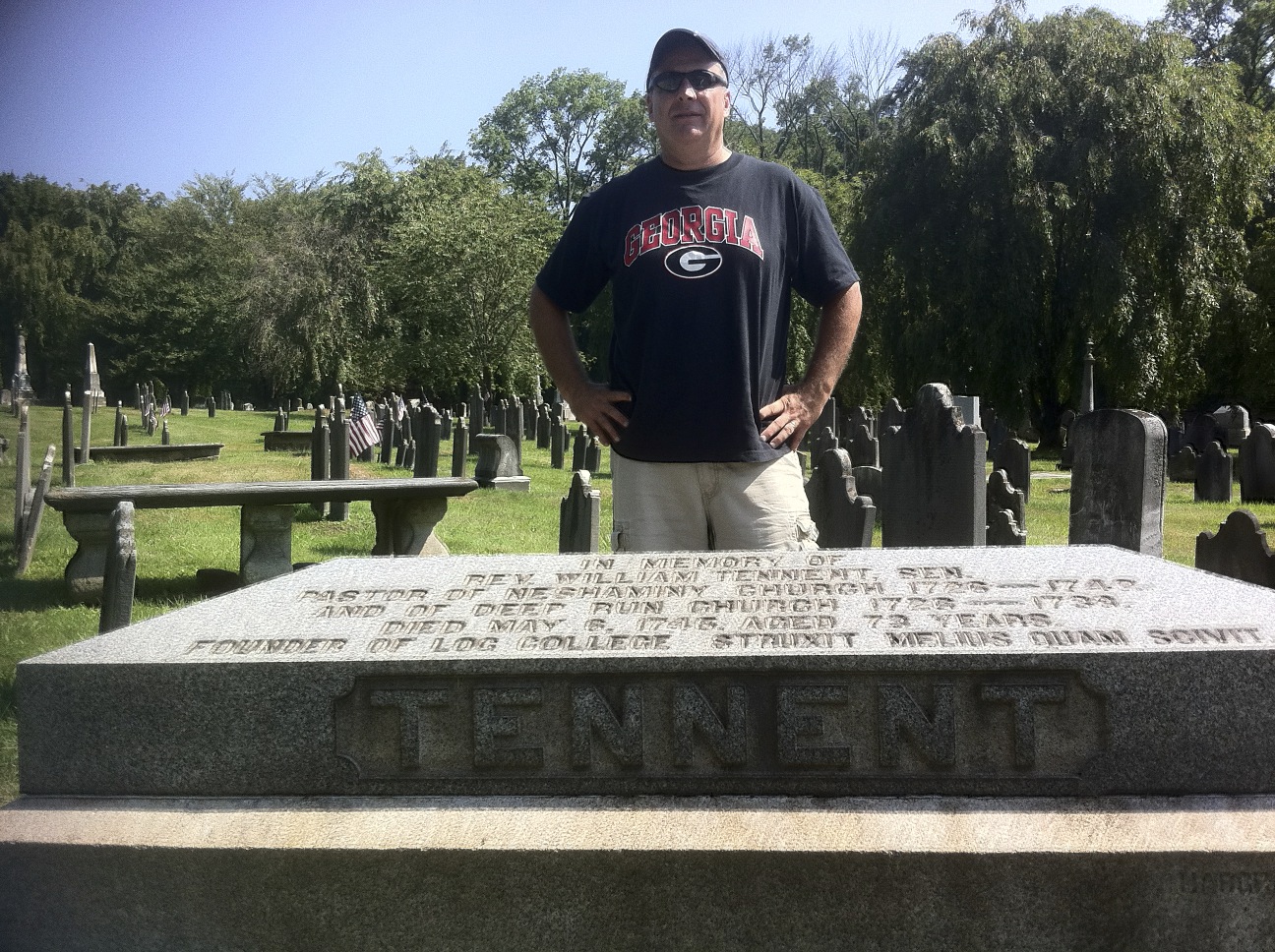
William Tennent Sr. ministered faithfully to the ripe old age of 73 in 1746. His church has remained a Gospel light in southeastern Pennsylvania until this day. All four of William Sr’s sons went into Gospel ministry. Two of them, Gilbert and William Jr became major players in the Great Awakening and will be the subjects of future posts. The elder Tennent is buried in the church cemetery of Neshaminy Presbyterian Church. On his tombstone is inscribed a most appropriate epitaph. Translated from the Latin is says,


He built better than he knew


Your Blogger at William Tennent's grave in the cemetery of
Neshaminy-Warwick Presbyterian Church.  The original
cover slab is in the church.  George Whitefield preached to
thousands on two occasions right behind where I'm standing


I had the chance to visit William Tennent’s grave with a group of friends and fellow ministers from several Sovereign Grace churches. Among the crew piling into a rented van were assorted pastors, interns, lay leaders, a church planting resident, a couple of guys headed to the next Pastors College class, a seminary student, an international Christian relief worker (my brother John) and an African pastor. Besides the Tennent sites in Warminster we also traveled to Freehold NJ to see William Jr’s church and then to Princeton Cemetery where several Log College grads (as well as Jonathan Edwards and other future blog subjects) are buried.


Our roving Great Awakening band of brothers at the Log
College Monument in Warminster, PA.


Wednesday, July 4, 2012

John Hancock

Boston, MA. Visited July 2003


John Singleton Copley Portrait


John Hancock is more than just a practitioner of great penmanship and inspiration for a full range of insurance products. He is a remarkable Founding Father whose leadership and courage played a key role in American independence.


John Hancock was born in January 1736 in the hamlet of Braintree (later Quincy), MA, also the hometown of his fellow Founding Father John Adams. His father was a well respected minister who gave his family a comfortable living. When John was seven his father died and his mother decided to send him to Boston to be raised by his wealthy merchant uncle Thomas Hancock. John graduated from Harvard College and began to work in his uncle’s shipping concern, learning the business from the ground up. In 1764 Thomas Hancock died and John inherited the entire estate including the business empire and thousands of acres of property, making him instantaneously one of the wealthiest men in the colonies.

Will Smith as 'Hancock' - not a
faithful biography

Unfortunately, John had little time to enjoy his newfound largesse. Within a month of his uncle’s death the Sugar Act was enacted, inaugurating an escalating tension between the Colonies and the Crown over ‘taxation without representation’. The tension centered in Boston. As a prominent Bostonian whose livelihood was tied to good relations to British interests, Hancock initially found himself advocating cooperation with the government. But with the Stamp Act of 1765 he began to increasingly side with the emerging patriot movement and came under the influence of the radical Samuel Adams. Through the next few years of turbulence leading up to the Boston Tea Party in 1773 Hancock’s stature as a patriot grew. His speech on the fourth anniversary of the Boston Massacre on March 5, 1774 was distributed throughout the Colonies and broadened his reputation beyond New England. Here is a quote from the speech that provides insight into Hancock as a leader and as a man.

"I have the most animating confidence that the present noble struggle for liberty will terminate gloriously for America. And let us play the man for our God, and for the cities of our God; whilst we are using the means in our power, let us humbly commit our righteous cause to the great Lord of the Universe, who loveth righteousness and hateth iniquity. And having secured the approbation of our hearts by a faithful and unwearied discharge of our duty to our country, let us joyfully leave our concerns in the hands of Him who raiseth up and pulleth down the empires and kingdoms of the world as He pleases; and with cheerful submission to His sovereign will, devoutly say, "Although the fig tree shall not blossom neither shall fruit be in the vines, the labor of the olive shall fail and the field shall yield not meat, the flock shall be cut off from the fold and there shall be no herd in the stalls, yet we will rejoice in the Lord, we will joy in the God of our salvation." [Habakkuk 3:17-18]"


John Hancock played an indirect but key role in one of the touchstone events of the Revolutionary War. Having been chosen as a delegate to the Continental Congress, Hancock (along with Samuel Adams) attempted to make his way to Philadelphia while avoiding arrest by the British. The pair slipped into Lexington in mid April 1775 just as the British were commencing their march toward Concord. Patriots in Boston sent messengers to Lexington to warn the two leaders, one of whom was Paul Revere. Due to his Revere’s ride and the ‘shot heard round the world’, Hancock and Adams escaped capture and made it to Philadelphia. Due to his standing and proven fidelity to the Colonial cause John Hancock was elected president of the Congress. It was during his time in the Congress that Hancock married, though both children from the marriage did not survive to adulthood.


John Trumbull's famous depiction of the signing 
of the Declaration of Indepedence 


For a stirring depiction of the
ratification vote see this scene 
from the acclaimed 'John Adams'
While he served tirelessly as president of the Congress throughout most of the Revolutionary War, it is John Hancock’s signature on the Declaration of Independence that may best define his leadership. Legend has it that Hancock wrote his signature with large flourish because he wanted to make sure the King could read it without spectacles, but the truth is at the same time more mundane and heroic than the legend. In reality, as president of the Congress, Hancock’s signature was the only signature on the original Declaration, as was customary at the time. That’s why his signature is so prominent. In effect, John Hancock was the first Founding Father to officially declare his rebellion against Britain. Within a month all of the delegates signed the document as a show of unity in the cause of liberty.


Hancock Statue in Boston

Prior to the end of the war Hancock requested a leave of absence from the Continental Congress in order to lead troops into battle, though he lacked any command experience. His one opportunity in the war led to a minor defeat and an apparent reality check on his military ambitions. With the end of the war the wildly popular Hancock was elected first governor of the Commonwealth of Massachusetts. With the exception of a short hiatus, it was an office he would hold for the final 13 years of his life.


The blogger at Hancock's grave -
inappropriately attired in an OBX
tee shirt
John Hancock died in October 1793 at the age of 56 after a long period of increasingly debilitating illness. He was afforded a lavish funeral and was laid to rest in the Old Granary Burial Ground at the edge of Boston Common. The relatively small cemetery is often mistaken as the church cemetery for Park Street Church, but in fact the church was built nearly a hundred years after the establishment of the cemetery. Old Granary is a must stop on the Freedom Trail. In addition to John Hancock it also holds Samuel Adams, Paul Revere and other notables from Boston’s Colonial past. I’ve been there a couple of times, most recently with my brother John and friend Bauer Evans.


An illustration of Park Street Church and the Old Granary
Burial Ground


Saturday, June 23, 2012

Louisa May Alcott

Concord, MA.  Visited July 2003


This is the first entry of a group of writers buried in Sleepy Hollow Cemetery in Concord, MA. Our subject is 19th Century author Louisa May Alcott. Alcott’s fame is largely built on the enduring popularity of her 1868 semi-autobiographical novel “Little Women” and its lesser known sequel “Little Men”. When you think about it “Little Women” is an author writing a story about writing a story about herself. But the novel (and the films made from it) has always had an audience; and Alcott an enduring place in American literature because of it.


Louisa May Alcott was born in November 1832 in the Germantown area of Philadelphia. Her parents were transcendentalists – part of a group of intellectuals who developed a philosophy around the inherent goodness of man and nature and the corruptive influence of institutions. Her father, Bronson Alcott, moved the family to Massachusetts to be part of the progressive philosophical scene, settling in Concord among an intellectual community including Emerson, Thoreau and Nathaniel Hawthorne. Bronson’s desire to build an educational system around his beliefs led to several failed utopian ventures and years of near poverty for the family. But the closeness of family ties that comes through in “Little Women” seems to reflect the genuine experience of life in the Alcott home. Eventually with the aid of some inheritance the Alcotts were able to settle into a home they called Orchard House in the village of Concord.


Orchard House, the Alcott home in Concord.  My wife Jill and friend
Linda Evans loitering out on the front step


Financial troubles in the family required Alcott to labor as a seamstress and governess throughout her formative years. But she began to show promise as a writer early, penning magazine articles on a variety of subjects. During the Civil War she briefly served as a nursing aid at Union Hospital for Wounded Soldiers in Washington DC. The letters written about this experience were formed into magazine articles and became Alcott’s first critically received published work. Following the war she wrote a number of fictional pieces in the popular sensational style of the era.


130-23 MacDougal Street in Manhattan.
Alcott composed "Little Women" in a
second story bedroom.  Window AC
units were added later. 

After a year in Europe she returned to the States and settled in an uncle's house in Manhattan.  It was here in 1868 that she published “Little Women”.  This was actually the first half of what was to become the novel we know now. The book was an immediate critical and commercial success. G. K. Chesterton observed that the natural setting of the novel anticipated literary realism by 30 years. “Little Women” established Louisa May Alcott as an author for life. The income derived from this book and a few subsequent works allowed Alcott to bail her family out of significant long term debt and set herself in financial security for life.


"Little Women" has been turned into two memorable films.  Check out the trailers for each here - the 1949 June Allyson version and the 1994 Winona Ryder version.


A matronly Louisa May Alcott at work

Louisa May Alcott never married. She was a significant figure in the feminist and suffragist causes of the late 1800’s. In later years Alcott suffered from various physical ailments. She died of a stroke in Boston at the age of fifty-five in March 1888.


Louisa May Alcott is buried a family plot in Sleepy Hollow Cemetery in Concord, MA. This isn’t the same Sleepy Hollow from the Washington Irving story, which is in New York. But it is a quaint old New England burial ground with a lot of character. Alcott is buried on Author’s Ridge, a section of the cemetery where Ralph Waldo Emerson, Henry David Thoreau and Nathanial Hawthorne are also buried. I first visited the cemetery when I was on a trip to see my brother who was at Gordon Conwell Seminary. We had driven out on a history tour which included Lexington and Concord. It was near dark when we got to the cemetery and walked up to Author’s Ridge. It’s a pretty spooky place to go at night – with an old wrought iron fence, narrow winding path and tightly packed headstones. I think we both got a bit weirded out by the experience. But I took pix anyway – its what I do.


Alcott's grave in Sleepy Hollow.  This was taken during a
visit with my friend and fellow pastor Bauer Evans and his
wife.  Earlier in the day, not as gloomy. 


Sunday, May 27, 2012

Man o'War

Lexington, KY. Visited April 2006


May is racehorse month at ISDP. Having thus far essayed the great  Secretariat  and the tragic Barbaro  we’re going back in time. This month’s subject is arguably the most dominant thoroughbred in the history of racing, the legendary Man o’War.


Man o'War with owner Samuel Riddle

Man o’War was foaled in March 1917 in Lexington, KY, bred by the Belmont family (of Belmont Racetrack fame). As a yearling he was sold to Samuel Riddle of Delaware County, PA who raised him at Glen Riddle Farm in Berlin, MD.


Here's a good brief video bio about Man o'War.


Man o’War began his racing career in impressive fashion with a six length victory at Belmont Park. After winning his first six starts Man o’War walked up to the starting line of his next race. In this era of racing there was no starting gate.  Horse races started with the lifting of rope along the starting line. Unfortunately the race started with Man o’War facing the wrong direction. Having to turn 180 degrees just to begin the race, he was in catch up mode from the get go. As the race came down the stretch Man o’War was bearing down on the leaders, but came up a nose short, finishing second. The winning horse was fittingly named Upset. It turned out to be the only loss of Man o’War’s 21 race career.

Man o'War in his only career loss, an upset to Upset


Man o'War ran his three year old campaign in 1920.  The Triple Crown concept had just come into popularity the year before in 1919 with wins by Sir Barton in the Kentucky Derby, Preakness and Belmont Stakes. However Samuel Riddle ended any idea of a back to back Triple Crown winners because he felt the Derby was too early in the year for a three year old to run. So Man o’War’s first start was at the 1920 Preakness. He won the race in a track record time, then went on to the Belmont where he won by 20 lengths over the only other horse entered; but nevertheless in track record time. He was so dominant as a three year old that it became difficult to find horses to run against him. In one race a last minute competitor was found, but wound up losing to Man o’War by 100 lengths. Lest one assume that the race was just a leisurely gallop, Man o’War set a world record for the distance with no competition. The horse nicknamed 'Big Red' raced eleven times as a three year old before retiring at the end of 1920.  His last race was a match race against 1919 Triple Crown winner Sir Barton, which he won by seven lengths.


Man o'War's final resting place at Kentucky
Horse Farm.  I was there by myself so I
used the standard 'Phillies hat in the
shot' to verify an authentic visit 


Man o’War was retired to stud at Faraway Farm in Lexington, KY. Above is some nice rare video of the horse in retirement.  What has cemented the horse’s legendary stature is his remarkable success on the track and as a sire. He fathered 64 stakes winners and several Triple Crown race winners. His best known son was War Admiral, Triple Crown Winner in 1937. Man o’War was the grandfather of the equally legendary Seabiscuit. Big Red lived a long and productive retirement, eventually dying of a heart attack in 1947 at the age of thirty. He was originally buried at Faraway Farms but was moved in the 1970’s to a prominent site at Kentucky Horse Park in Lexington. He’s buried there with his son War Admiral. I’ve visited the park a couple of times; originally on a little side trip prior to the first Together for the Gospel and most recently in October 2011 on an excursion prior to the CCEF Living Faith Conference.


Now for the big question – who’s the greater horse - the better "Big Red" -  Man o’War or Secretariat? Here’s how I break it down. Man o’War's race record is simply amazing.  And his success as a stallion in producing winners is remarkable.  Secretariat was just faster. And Secretariat ran overall against better competition and larger fields. What sets Secretariat apart is that his best times remain extraordinary times even compared to competition nearly forty years after he ran his last race. Like all time records, improvements in the sport over time should result in lower race times.  But Secretariat's Belmont race remains the greatest single performance by a racehorse in history. So the winner, by a nose, is Secretariat!

Just for fun, your blogger on the backstretch at Pimlico
track (site of Man o'War's first triumph) a few minutes
after the 2012 Preakness, won by I'll Have Another


Monday, April 30, 2012

Davy Crockett

San Antonio,  Texas. Visited May 2011


Davy Crockett was born in east Tennessee in August 1786. His father fought in the American Revolution, most notably in the Battle of Kings Mountain. We know a good bit about Davy Crockett’s early years because he had the foresight to write his autobiography; though the details are certainly open to question on a number of fronts. It would seem that his version of his life story is much of the basis for the common epithet, ‘King of the Wild Frontier’. What is reliably known is that in his teens Crockett found himself largely on his own and forced to develop survival skills on the frontier of the new state of Tennessee. He was married at 20 and eventually moved his wife and three children farther into the frontier of West Tennessee. His wife died on the frontier and Crockett remarried at 29, a union that resulted in three more children added to the family.


Davy Crockett built his reputation as a soldier as a militia commander in regional Indian wars, rising to the rank of lieutenant colonel. A natural leader with a burgeoning reputation, he was elected to Congress at the age of 40 in 1826. While initially a supporter of the policies of Andrew Jackson, he proved to be a man of his own mind in Congress. Opposing Jackson on some key issues, Crockett lost his seat in 1830 but was re-elected in 1832. Davy Crocket can probably be credited with publishing the first candidate biography, releasing A Narrative of the Life of David Crockett - Written by Himself just prior to the congressional campaign of 1834. What politician Crockett seemed to lack was the people's touch, as evidenced by the following comment,

"I told the people of my district that I would serve them as faithfully as I had done; but if not ... you may all go to hell, and I will go to Texas.”


Your blogger in front of the Alamo circa 1986
Not surprisingly Davy Crockett soon found himself no longer in Congress and on his way to Texas. It appears that he went west intending to eventually resettle his family there, but his more immediate interest seemed the battle for Texas independence. He arrived in January 1836, quickly enlisted in the Texas militia and headed to San Antonio, arriving in early February at a little Spanish mission called the Alamo. Seeking to put down the Texas rebellion, Mexican General Santa Anna marched 1,500 troops to lay siege to the Alamo and its approximately 200 defenders. The siege at the Alamo lasted less than two weeks. Realizing that the makeshift fort was vastly outmanned, the commander William Travis sent Crockett and two others on a secret mission through the enemy lines to get reinforcements. The squad was able to locate some Texians and fight back through the lines to the Alamo, but it was a futile effort. On March 6, 1836 Mexican Troops stormed the mission and overran the Texians, killing all the soldiers in the fort, including Davy Crockett.  A short perspective on the battle produced by HISTORY can be viewed here.


Famous 'Crockett-centric' painting of the Battle of the Alamo


The defenders of the Alamo were reportedly burned and buried at the mission by Santa Anna’s troops. A few years later the reputed remains of Crockett, Colonel Travis and Jim Bowie were gathered and buried together at the Roman Catholic San Fernando Cathedral in San Antonio. In the 1930's the remains were dug up in a reconstruction project and placed in a sarcophagus box in an antechamber of the new cathedral, where they remain to this day.


Marble plaque at San Fernando Cathedral. The panel
on the right is one of those things that makes grave
searching so much fun


My son Grant sporting a
classic coonskin cap -
appropriate attire for all
occasions
The legend of Davy Crockett grew out of his own self-promotion as well as his true heroic service in the cause of Texas Independence. The Davy Crockett coonskin cap was requisite haberdashery for any boy growing up in the late 1950’s and early 1960’s as Davy Crockett became an iconic figure in TV and movies.


Choose your favorite Crockett....


Fess Parker...

 OR

  
John Wayne

The Davy Crockett atomic bomb
launcher

A less well known appropriation of Crockett’s legacy occurred in the 1960’s as the U. S. military developed an infantry-operated atomic bomb launcher that was intended to be carried into battle for tactical nuclear warfare. I saw one of these on a visit to West Point a few years ago. It had a launch range of 2000 yards, though the blast circumference of the bomb it could launch would be several times that distance. This made it essentially a suicide weapon for any unlucky soldiers assigned to fire it.  Fortunately it was never fired on enemy troops or even tested with a real atomic bomb. The plaque on the launcher in the museum said it was discontinued in the late sixties because it was ‘considered impractical’. 

Another quircky modern reference to Davy Crockett that I’ve come across is the following video of They Might Be Giants - The Ballad of Davy Crockett in Outer Space


Your Blogger at San Fernando Cathedral
in San Antonio

I visited the San Fernando Cathedral with my friend Jay Walker on our way to the airport from an arts retreat at Laity Lodge in the Hill Country outside San Antonio. It was a Sunday when we arrived and the church was filled with worshippers at a Spanish Mass. Undaunted, and possibly rude, Jay and I squeezed our way through the crowd and snapped a few pictures during gaps in the liturgy. Not the preferred method of gathering material for this blog.  But I think the King of the Wild Frontier would approve.


Having parted the crowd  to get this picture I think my 
face reveals just a bit of awkward guilt.  At least I took 
my hat off.