Wednesday, June 15, 2011

Jean-Michel Basquiat


Brooklyn, New York. Visited April 2011


This post focuses on mercurial 1980's artist Jean-Michel Basquiat  - a tragic story of remarkable gifts and a life struggling to live with them. I asked my friend, artist Jay Walker to talk about Basquiat’s life and art.

When I list the artists that influence my work, Jean-Michel Basquiat is always the one that is curious to people.

"Unquiet Mind"
Basquiat rose to notoriety at the young age of 20, coming out of the New York graffiti movement under the tag name “Samo”, in which he would spray paint Dadaistic truisms. After being reviewed in Artforum by Rene Ricard, who dubbed him the “Radiant Child”, and then being discovered by the booming 80s New York art scene, Basquiat was the youngest artist in recent history to take the art world by storm. Eventually being exhibited internationally, making more money than he knew what to do with, being featured on MTV, dating many starlets (Madonna included), and developing a close relationship with Andy Warhol (whom many thought was exploiting the young artist), the pressures of fame came crushing down on Basquiat. This led to a lagging career, increased drug use, and the eventual overdose at the age of 27 in August 1988
.


Basquiat’s work is classified as Neo-Expressionism and he is often compared to Van Gogh, due to his similar lack of formal training, troubled life, and out of the norm expressive work. Some make the case that the adulation of the art world for Basquiat was penance for its oversight of Van Gogh.


"Fallen Angel"
His work is a dichotomy of tribalism and refinement. Basquiat would point out that it was Europe meets Africa, a form of Creole, like being Haitian, which his father was (his mother was institutionalized most of his life). He avoided being a black mascot for the art world, but he did embrace his heritage of jazz and identified with fellow African-Americans who had risen above social barriers.


Why is Basquiat important to me? His style of work is not similar to mine, though I hope a more direct influence will happen. He made the work he wanted to, he tapped into something deep inside, was unafraid of what people thought of what he created, and reached the level that few are able to attain in a lifetime, all while being very young. He is also a cautionary tale. What happens when fame and the market play to heavily into an artist’s life? What happens with a meteoric rise? What happens when art is all that matters?


If you want to know more about him, watch my favorite movie – "Basquiat"  a film by the painter Julian Schnabel, which is a loose biography from Schnabel’s first hand account of Basquiat’s life.

"Self Portrait"

Personally speaking, as I’ve looked at Basquiat’s work, I’m not sure I can say I ‘like’ it. But I can’t seem to stop looking at it.  You can take a look at his paintings at a number of sites online.  Basquiat is also featured in alot of short video.  The one I found most interesting is "Painting Live - Downtown (1981)"


David and Zac on the hunt


The main reason I wanted to include Basquiat in this blog right now has to do the experience of finding his grave. I visited  Green-Wood Cemetery, a beautiful historic cemetery on one of the highest hills in Brooklyn overlooking downtown Manhattan, just a couple of months ago. I was there with my friends, photographer David Sacks and Zac Martin, pastor of Sovereign Grace City Church. While the cemetery office gave us a map showing the approximate location of Basquiat’s headstone, when we got to the section where he’s buried we couldn’t find it. After about fifteen minutes of wandering around among the graves we saw a small elderly gentleman approaching us. He said, ‘you looking for that artist? I’ll show you where he is. He’s buried behind my daughter.’

He walked us down a row of low symmetrical headstones, literally back to back with each other. ‘Here’s my daughter. He’s on the other side.’ He graciously allowed us to take the picture I’ve included here. And then he set to the sad dignity of clearing away leaves and weeds from his daughter's stone. We stood there for a few minutes, silent; looking down at the grave of a gifted man whose life was cut short in its prime. A few feet away a grieving father faithfully tended to the final resting place of a young woman whose gifts and story are unknown to the world.

As we turned to leave I wondered if this wasn’t an opportunity to offer him hope. So as I thanked him for helping us I said, ‘Sir what you’re doing speaks deeply to me – thank you…’ But before I could finish, he gently held up his hand; the tears in his eyes told me there was a line of interaction he didn’t want to cross. And he said, ‘You never want to do what I’m having to do’.


As the Bible says, death is a curse. It leaves gaping holes of grief in families. It silences the beauty of God-given creativity. But death has its own enemy. And someday it will be defeated – swallowed up in the victory of Christ (1 Cor. 15:34). As I pray for that faithful old man I pray that when that victory comes, he will be part of it.

Come Lord Jesus.

Monday, May 30, 2011

Omar Bradley

Arlington, Virginia. Visited September 2009


In honor of Memorial Day I’m doing a blog on my favorite World War II Commander, General Omar Bradley. Bradley’s combination of leadership skill, tactical innovation and personal integrity made him embody the best in military leadership. And it is characteristic of the man’s lack of self-promotion that he so seldom comes up in the conversation of great heroes of the Allied cause in World War II. But one would be hard pressed to find a story better suited to the American ideal of what a true soldier should embody. Known as the ‘soldier’s general’, Bradley rose through combat experience to command the largest Army group in history under one man; was the first chairman of the Joint Chiefs of Staff and was the last soldier ever promoted to the rank of five star general.  You can see a brief Bradley Bio here.


His story is right out of Life Magazine. Omar Bradley was born to a poor family in a log cabin in rural Missouri in the year 1893. He worked hard to get a basic education, excelled at sports and was working with the railroad to make enough money to attend the University of Missouri when his Sunday School teacher suggested he apply to West Point. Bradley got an appointment based on outstanding test scores. While at West Point he excelled at extra-curriculars but was an average student, graduating in 1915 just as World War I was breaking out.

Much to his dismay, Bradley never made it to the European theater, doing stateside duty on the West Coast. Yet he began to distinquish himself as a skilled organizer and developed a keen understanding of battlefield tactics. In the decades between the wars he had several posts as a student and instructor at key military colleges which honed this knowledge base and which allowed him to advance in rank as a professional soldier. He came to the notice of George C. Marshall, who would go on to run the military during World War II.


As World War II broke out he was promoted to the rank of brigadier general and given the responsibilty of ramping up two infantry divisions which would play significant roles in Europe. But as the North African front exposed the ill preparedness of the green American troops, Bradley’s organizational and leadership skills were called upon to reverse losses against the Germans and help prepare for an invasion of Sicily and Italy beyond. During this campaign he served under George Patton.
Omar Bradley, Dwight Eisenhower
and George Patton


The Allied breakthrough in Italy created the opportunity to plan a large scale invasion of France and Omar Bradley was called into the center of Operation Overlord – the D Day invasion. In fact much of the eventual plan for the Normandy Invasion was the result of Bradley’s planning and tactical innovation. It fell to Bradley to command the US invasion of Omaha and Utah beaches. On November 6 1944 the Allies launched the D Day invasion and after significant struggle a beachhead on the mainland was secured. It is about this hardfought triumph that Bradley said, “Bravery is the capacity to perform properly even when scared half to death.”


During the closing years of the war Omar Bradley became indispensable to the Allied command under Dwight D. Eisenhower. Almost alone among the top echelon of generals Bradley seemed impervious to politics and was the only commander able to effectively manage the combustible George Patton. Eventually the entire US force in Europe was placed under his command, meaning he personally oversaw a fighting force of 1.3 millions soldiers. It was his tactical plan in connection with the Soviet advance that ultimately led to the defeat of the German army and the end of the war in Europe.


Bradley Statue in Moberly, Missouri


After the war General Marshall personally requested Bradley to oversee the Veteran’s Administration. With the rapid downsizing of the wartime army, the VA was a backwards department unprepared to meet the needs of the fighting men it was created to serve. Within just a couple of years Omar Bradley’s leadership and organizational skills had transformed it into a agency that was a signficant force in allowing the ‘greatest generation’ find its way home from the war.


Omar Bradley receiving his fifth star
from President Harry Truman

In 1949 Omar Bradley became the first chairman of the Joint Chiefs of Staff. During his tenure he received his fifth star, becoming the last “General of the Army” in US history. The last post in his long distinguished career was first chairman of the Military Staff Committee of the North Atlantic Treaty Organization. Bradley retired in 1953, and began a long career in the private sector, while also serving all of the post war presidents with his counsel and experience in military matters. The soldier’s general emerged as one of the few top commanders from World War II to grasp the fundamental change in the nature of war that came with the atomic age. Reflecting on his experience as a warrior for freedom Bradley commented,


“We've learned how to destroy, but not to create; how to waste, but not to build; how to kill men, but not how to save them; how to die, but seldom how to live.”


Omar Bradley funeral procession to Arlington
National Cemetery
Omar Bradley died in April 1981 and was buried at Arlington National Cemetery with full honors. My singular personal awareness of the general is when I watched the funeral of Dwight Eisenhower in 1969. The TV kept showing the aging general standing in full dress uniform honoring his former commander. Bradley was the last of a stellar generation of American commanders from World War II to pass from the scene.


There is a special reason this visit to Arlington National Cemetery where I saw Bradley also makes this Memorial Day blog meaningful. It was one of the last times I had the chance to spend an extended time with my dad. He had taken the train up to Philly so that I could drive with him down to Arlington to attend the memorial service of a cousin, Richard Allen. Vice Admiral Dick Allen had served as a fighter pilot in the Vietnam War, had captained the USS America in the Libya bombing raid in 1986 and had been head of the North Atlantic Naval Air Wing at the end of a distinguished naval career. He had fought a heroic battle with cancer and had testified greatly in that battle to his trust in Jesus Christ. Along with my son Grant and my nephew Ben we had the priviledge of attending as family a full honors burial at Arlington, which was very moving.


Bradley Fighting Vehicle on the move in Iraq


So this blog is a chance to honor the soliders of over a century of service to our country. Omar Bradley, soldier and commander through two world wars, Jake Farmer, citizen soldier in post-war Europe and the Korean Conflict and Dick Allen, fighter pilot in Vietnam and Naval officer through the end of the Cold War and in the War on Terror.


On this Memorial Day let us salute the men and women who dedicate themselves to serve our country in the military with courage and fidelity and those who have given their lives in the cause.


Other blog subjects buried at Arlington Cemetery:

Joe Louis


Friday, May 13, 2011

Barbaro

Louisville, Kentucky. Visited August 2009


I’ve made a command decision. For as long as I’m doing this blog I’ve decided that each Triple Crown season I will feature a racehorse. You might say, ‘how long can he sustain that?’. Don’t worry, I’m well stocked with options. Perhaps you should worry….

Barbaro
I’ve already featured the great Secretariat in the Fall of 2010, so for this Triple Crown season I’m going to cover the tragic story of Barbaro.

Barbaro was foaled at Lael Stables in West Grove, PA, making him the third horse with Pennsylvania connections in a row to dominate the Triple Crown races (following Smarty Jones and Afleet Alex) – a very unusual trifecta for a sport ruled by Kentucky-bred colts. He was descended from the great Mr. Prospector, which made him a cousin to other recent Kentucky Derby winners Big Brown, Afleet Alex, Smarty Jones, Funny Cide and Fusaichi Pegasus. He was trained at Fair Hill Training Center in Maryland by Michael Matz.


Riding to victory in the Kentucky Derby
Entering the Triple Crown season of 2006 Barbaro was undefeated and had been set in as a 6 to 1 second favorite in the Kentucky Derby on the basis of a strong Florida Derby win. Ridden by Edgar Prado, Barbaro dominated the Derby, winning by six and a half lengths over a 20 horse field – the largest margin of victory in a Kentucky Derby in 60 years. On the strength of that victory he seemed to poised to make a serious run at the Triple Crown.  View his thrilling Run for the Roses here.


Edgar Prado calming Barbaro after breaking
down at the Preakness

However, tragedy struck two weeks later at the Preakness Stakes when, shortly after breaking from the gate the horse veered sharply and pulled up lame. Prado immediately dismounted and supported the horse’s leg as track personnel rushed to the scene. Barbaro was able to be loaded onto an ambulance and carried from the track. Upon examination it was found that he had broken 20 bones in his right hind leg.


Barbaro receiving treatment at New Bolton Center
Eventually the horse was transferred to the University of Pennsylvania’s equine veterinary center in New Bolton, PA, where specialists tried to reset the leg and prevent further damage. For over six months veterinarians tried various means to heal Barbaro’s injuries, but the infections that are all too common with thoroughbred horse leg injuries eventually made it impossible for the horse to stand without pain. Medical remedies exhausted, it became obvious to the doctors that Barbaro’s condition would only worsen with time. Owners Roy and Gretchen Jackson stood in attendance as Barbaro was put down January 29, 2007.

It was decided that his remains would be buried at the entrance to Churchill Downs in Louisville. A statue marking his grave was unveiled at the site in April 2009.


Like many people I admired the beauty and power of the dark brown colt. His impressive Kentucky Derby win catapulted him to national attention, making his accident all the more tragic to racing fans and horse lovers. The nation kept remarkable vigil through the ups and downs of his treatment at New Bolton. I live just about 20 minutes from the stables where Barbaro was raised. The Equine Center is right on Route 926 heading from my house to my in-laws so I had the chance to drive by it while he was there a number of times. I always saw new get well wreaths and posters from well wishers covering the entrance.


While attending a counseling conference at Sojourn Church in Louisville I had the opportunity to tour Churchhill Downs and see Barbaro’s beautiful memorial just a few months after it was unveiled.

Wednesday, April 13, 2011

George Whitefield

Newburyport, Massachusetts. Visited July 2003


When you consider the ministry of George Whitefield, the numbers are staggering. To adequately consider the physical reality of the breadth and impact of his influence consider his world. In an era when books were the primary means of mass communication, Whitefield published nothing beyond a handful of sermons and some biographical material. He lived in a world where the only transportation was horse, foot or ship. Yet he had massive influence on two continents by virtue of preaching alone. He traveled to the American Colonies seven times, spending over three years of his life onboard a ship. In the course of his 35 year ministry he preached at least eighteen thousand times – addressing audiences totaling up to ten million people. In a world with no voice amplification, Whitefield regularly preached to crowds in the thousands of people. Whitefield’s sermon on Boston Common in his last preaching visit to the city drew 23,000 people, more than Boston's entire population. So who was this extraordinarily influential evangelist?


George Whitefield was born to a Gloucester, England innkeeper’s family in December 1714. His father died when he was two, and George grew up helping keep the inn afloat. In his youth Whitefield was attracted to the theater; an interest that shaped his emotionally evocative preaching style later in life. He was able to attend Oxford University as a servitor, a student who received free tuition in exchange for serving the needs of wealthy students. During his time in college Whitefield read Henry Scougal’s The Life of God in the Soul of Man, which threw him into spiritual crisis. After an extended period of anguish over the state of his soul, the twenty-one year old student embraced the saving forgiveness of God. In later years he would say, "I know the place.... Whenever I go to Oxford, I cannot help running to the spot where Jesus Christ first revealed himself to me and gave me the new birth."


Whitefield had received his copy of Scougal from John Wesley, whom he had met at Oxford. Along with his brother Charles, John had formed ‘the Holy Club’, a society of students desiring sincere devotion to Christ. A relationship was born in that college ministry between Whitefield and the Wesley’s that endured, though often tempestuously, for the remainder of the evangelist’s life.


Whitefield in the fields
 Upon graduation, George Whitefield was ordained into the Anglican Church, but was not placed in parish ministry. From the get go, Whitefield’s preaching gift was remarkably used. Very soon he recognized that his specific call was to evangelistic preaching among an increasingly irreligious and unbelieving culture. Whitefield soon took to the fields where his booming voice and passion gathered far more people than could be accommodated in any structure. In time he did accept the curacy of a church in Savannah, Georgia, which led to the creation of an orphanage that would be a work of charity he tended all his life.


There are great books that cover the breadth of Whitefield’s life an ministry. If you're interested in a brief bio, check out this 'preacher on preacher' video - D. Martyn Lloyd-Jones on George Whitfield

But here are some seemingly contradictory aspects of the man that I find fascinating.

  • Whitefield was a ‘Free Gospel Calvinist’ – committed to the doctrine of election and unmerited favor but at the same time bold to call all his hearers to repentance and faith in Jesus.
  • Whitefield was, sadly, an advocate of the institution of slavery in the Colonies, though at the same time he actively preached the Gospel to slaves, treating them as souls capable of trust in Christ, not as semi-human property, which is what most people in his time thought.
  • Due to his influence Whitefield was always a controversial figure, but in private he did more to build bridges and heal divisions than any other prominent religious leader of his day.
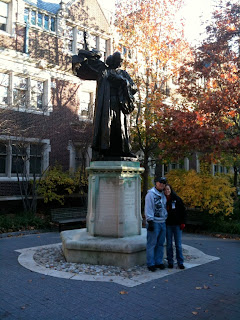
Me and my daughter Kelsey at the Whitefield
statue at Penn
One of the remarkable themes of Whitefield's life was his enduring friendship was with the non-believing humanist Benjamin Franklin. Franklin admired Whitefield’s intellect, his character and his gifts of communication. Whitefield relentlessly prayed for Franklin's salvation to the end of his life.  What little publishing occurred of Whitefield’s ministry was done by Franklin the publisher. It was through the friendship of Whitefield and Franklin that the University of Pennsylvania began in a hall specifically built for the preaching of Whitefield in Philadelphia. There is a great statue of Whitefield in the Quad at Penn upon which the following words from Franklin are written,

"I knew him intimately upwards of thirty years. His integrity, disinterestedness and indefatigable zeal in prosecuting every good work I have never seen equaled and shall never see excelled."


It might be said that over a 35 year ministry George Whitefield effectively preached himself to death. Sick with severe asthma and worn out from his labors, Whitefield’s last sermon was preached in Exeter, MA. When those near him urged that he decline the preaching opportunity, Whitefield offered this remarkable reply, “Lord, if I have not yet finished my course, let me go and speak for the once more in the fields, seal thy truth, and come home and die.”  He traveled that night to Newburyport, spoke briefly to a small crowed as he struggled to bed in the parsonage of the Old South Church. At around 6:00 am the next morning, September 30, 1770, Whitefield the preacher was silenced on this earth and Whitefield the eternal worshipper entered into his heavenly reward.


The Old South parsonage at Newburyport, MA where
Whitefield spent his last night 


According to his wishes, Whitefield was buried in the basement of Old South Church, under the pulpit from which he had preached the Gospel. John Wesley, with whom he had theologically broken years before, preached his memorial service in London. My brother John and I had the chance to visit Whitefield’s crypt at Old South at the invitation of his friend Rob John (the current church pastor) when he was finishing his masters in church history at Gordon Conwell Seminary. If you go, also look at the little historic display in the entrance of the church. There is a small box there which at one time contained one of Whitefield’s forearms. Apparently a zealous Brit wanted to transport Whitefield back to the Isles bone by bone. But he regretted his thievery and remorsefully sent the bone back in the aforementioned box. The parsonage where Whitefield passed away is still standing next to the church.

George Whitefield's crypt in the cellar of Old South Church -
for some reason there is a plaster cast of his skull on a Bible
on the slab.


To become acquainted with George Whitefield is to realize that there will never be another like him.  His story illustrates a remarkable providence of God in bringing a man with remarkable gifts and a consecrated heart into a culture ripe for the message he was bringing.  We can't recreate the Whitfield model, but we can emulate the Whitefield passion:  “God forbid that I should travel with anybody a quarter of an hour without speaking of Christ to them.”

On the Penn Campus statue is the following epitaph.

The Reverend George Whitefield
Bachelor of Arts, 1736,
Pembroke College, Oxford
Humble Disciple of Jesus Christ
Eloquent Preacher of the Gospel


Yours truly at the front of Old South Church


We remember George Whitefield – eloquent preacher of the Gospel. How would he want us to remember him? In his own words:

Other men may preach the gospel better than I, but no man can preach a better gospel.


Wednesday, March 30, 2011

Johnny Unitas


Timonium Maryland – Visited November 2010


The classic card shot
A young boy who is nuts about football will often fix on one player as his hero for life. For me, growing up in the Sixties, that player was Johnny Unitas. I don’t know what it was about him – he was moving rapidly past his prime and played for a team, the Baltimore Colts, that I knew little about. But Unitas was my man.


Oddly enough, by the time I began to follow pro football in the late Sixties, Johnny Unitas was a throwback, an oddity of sorts. He was still sporting his signature crew cut when guys like Joe Namath were going Hollywood and hippie. And the black high-top cleats were unmistakably Unitas. Then there was the uncool number – 19 – which made it seem like he was perpetual walk-on trying to prove himself. But nobody could mistake that drop back and quick release. Watching quarterbacks like Peyton Manning and Tom Brady these days is akin to watching Unitas – field generals of limited raw athletic talent who think the game to another level, and take their teams with them to it.


I've got a feeling this was staged
Johnny Unitas was born in 1933 in Pittsburgh, the heart of the Western Pennsylvania ‘Cradle of Quarterbacks’ (think Lujack, Blanda, Namath, Kelly, Marino and Montana as well). He was first generation Lithuanian who lost his father when he was four and was raised in a blue collar home by his hardworking mother. Unitas played college ball at the University of Louisville, showing promise as a two way player but finishing with an undistinguished career for a mediocre program He was drafted in the late rounds by the Steelers but cut during camp, reportedly because the coach didn’t think he was smart enough to play at the pro level.


 The Unitas story gets folksy as he found work doing construction and played semi-pro football to keep himself prepared for another shot. He got it with Baltimore in 1956, who signed him as a back up, only to press him into action half way through the year due to an injury to the starter. Unitas never gave the position back.


For a bizarre experience check out
highlights of the 58 NFL Title Game
set to Survivor's Eye of the Tiger
Two years after becoming a starter for a perennial also ran team, Unitas led the Colts to the NFL championship in 1958. That championship game, a 23-17 victory over the New York Giants, was the first ever overtime game in NFL history, and remains the only NFL championship (including Super bowls) decided in overtime. Watched by a phenomenally large audience at the time of 45 million people, it is this game that is credited with putting pro football at the forefront of the professional sports world. Unitas was named MVP of the league that year, and followed that up with another championship and MVP award in 1959.


Throughout the Sixties Unitas remained at the top of his game winning two more MVP’s in that span. Increasingly limited by injuries and age, Unitas came in as a back-up to throw a touchdown in the Colt’s upset loss to the New York Jets and Joe Namath in the 1968 Super bowl. Two years later Unitas threw a touchdown in Super bowl V before being injured, and the Colts went on to beat the Cowboys for the championship.


Johnny U statue at Raven's Field in Baltimore

Johnny Unitas' career in Baltimore ended with a flourish in 1972 when, in a late season home game the Colts were winning handily, the fans started chanting ‘We want Unitas’. Knowing the quarterback would never go in the game just to please the crowd, the coach tricked him into thinking the starter was injured. Unitas went into the huddle, called a pass, and threw a long bomb for his last pass as a Baltimore legend.

At the height of his career Johnny Unitas set a record with 47 straight games throwing a touchdown pass. The next closest streak is 36 by Brett Favre. With due respect to Joe DiMaggio’s 56 game hitting streak, this may be the greatest individual record in team sports. When you consider that Unitas played in an era dominated by the running game, in entirely outdoor conditions, and that he was dependent on his receivers to score, this is a phenomenal accomplishment.


After retirement Johnny Unitas did broadcasting work and stayed in Baltimore. When the Colts were smuggled out town by Bob Irsay in 1984, Unitas cut his ties with the team in protest. Unitas welcomed the Ravens as the successors to the Colts and was an institution in Baltimore throughout his life. He died unexpectedly of a heart attack in the Baltimore suburbs in September 2002. At its 50th anniversary the NFL selected Johnny Unitas as its top player in its first five decades.


I visited the Unitas grave in Dulaney Valley Memorial Cemetery in Timonium, Maryland with my friend Joe Lee of Covenant Life Church. We were supposed to be meeting in Baltimore to talk about pastoral counseling strategies, but spent most of the time looking for dead people. My idea, not his.


Monday, February 28, 2011

Thomas Jefferson

Monticello, Virginia – Visited July 2006


Thomas Jefferson, third president of the United States, primary author of the Declaration of Independence, patriot, statesman, inventor. It is not hard to put TJ in the top tier of American icons. But Jefferson is also one of the most enigmatic figures in U. S. history – great statesman who was a poor public communicator; revolutionary war hero who never fought a battle, aristocratic owner of a huge estate yet virtually broke at the time of his death, eloquent spokesman for human freedoms, yet owner and exploiter of slaves.


Thomas Jefferson was born in April 1743 in the Virginia Colony to a successful planter with aristocratic status. He inherited the estate of his father in the foothills of the Blue Ridge and renamed it Monticello, which in Italian means ‘little mountain’. The great house of Monticello was Jefferson’s design, lifelong home, and the great passion of his life. Jefferson married in his late 20’s, and he and his wife had six children before her untimely death ten years later. Jefferson never remarried.


The Jefferson Memorial

Jefferson’s career as a lawyer began with graduation from William and Mary College, followed by a law practice and various local government positions; ultimately serving in the Virginia House of Burgesses. He was sent as a Virginia representative to the Continental Congress and in 1776 was chosen to be principle drafter of the Declaration of Independence. After independence Jefferson returned to Virginia to serve as state legislator and governor. He resumed national politics as part of the Congress of the Confederation, where he was selected to the key political ambassadorship to France. He returned from France to serve as the first Secretary of State under Washington.


Thomas Jefferson became vice president under John Adams and was reluctantly nominated for the presidency to succeed Adams and became the third President of the United States. Jefferson served two terms which included the Louisiana Purchase and the Lewis and Clark Expedition. Following his presidency Jefferson returned to Monticello, where he busied himself with developing his property, scientific experimentation and founding the University of Virginia. Jefferson sold his library to the U. S. Government, which became the formative collection of the Library of Congress. In one of the great ironies of American history, both Jefferson and John Adams died on the fiftieth anniversary of the ratification of the Declaration of Independence, July 4, 1826. He was buried in the family graveyard at Monticello.


Me and Melissa at Jefferson's grave


I’m not a big Jefferson fan. His Sally Hemmings scandal certainly cuts against the image of him as champion of equality. On the ‘American Patriots – Christian or deist’ scale, Jefferson’s a pretty solid ‘2’ (1 being ‘Humanist to the Max’ and 10 being ‘Evangelical and Vocal About it'). He’s the guy who cut the supernatural stuff out of the Bible to make his own humanist version.  But he did support separation of church and state, which has generally benefitted the cause of the Gospel over the large sweep U. S. history.  For a nice brief dramatization of Jefferson's humanistic perspective check out Jefferson and Adams debate from David McCullough's "John Adams"

Farmer gang loitering in front of TJ's crib

 My visit to Monticello occurred during a very hot summer vacation with the Farmer clan 180 years after his death. The day after we took a memorable and enlightening tour of Jefferson’s remarkable homestead, we played miniature golf. Only in America. Thanks Tom, for helping to make the ‘pursuit of happiness’ part of my cultural experience.


Jefferson in Paris - a statue along the Seine honoring the ambassador.
Jill and I came across it in a visit in May 2009


Monday, January 31, 2011

Ulysses S. Grant

New York City, New York – Visited May 2001


My favorite Grant photo
Reader's note:  In doing posts on the Civil War I will include both Union and Confederate figures.  I would appeal that these posts be read as human interest stories, not as commentary on that difficult period in American history and the slavery that required such a tragic war to be fought for its eradication.

Back in the fall I gave Robert E. Lee prime position as my first Civil War soldier posted in the blog. There are a lot more to come, but it only seems fair to go Union and bring in Ulysses S. Grant. At the end of the war U. S. Grant was the most popular figure in the Northern States, and that includes Abraham Lincoln. He was the military savior of the country, the man who finally whipped Bobby Lee and brought a victorious end to the cataclysmic national nightmare of the Civil War.

Like so many great historical figures, U. S. Grant was a compellingly contradictory figure. He seemed uniquely designed to lead men into battle, but besides being an expert horseman, showed little else in character or talent that would seem to confer greatness.


Ulysses Hiram Grant was born into a working class family in 1822. He showed enough early promise to earn what became an undistinguished education at West Point, graduating in the lower half of his class. It is at the Military Academy that his name was mistakenly changed from Ulysses H. to Ulysses S. Grant, though there was never a name associated with the S. His first true success in his military career came with two citations for bravery in the Mexican-American War in 1846-48. He was married in the 1840’s to Julia Dent and the two ultimately raised four children together. The 1850’s found Grant retired from the military and generally unsuccessful at anything he tried in its place – except for drinking, for which he apparently had a knack.


Grant statue in Vicksburg
Grant was drafted back into the Army at the start of the Civil War in 1861, and quickly rose to the rank of general due to some solid military victories at a time where nobody else in the Union army could claim success. Eventually President Lincoln, fed up with ineptitude or failure of his established military leaders, brought Grant from the Western theater to Washington to oversee the entire Union Army. Grant’s strategic genius recognized that the war was not about territory, but about victory and defeat. He knew that to win the war he had to defeat Robert E. Lee and put his army out of commission. So in 1864 through the first part of 1865 General Grant simply made the effort to fight as often and as aggressively as possible, using his superior numbers in men and equipment to wear down the Confederate Army. Ultimately this strategy worked, resulting the effective end of the war with the surrender of Lee at Appomattox Courthouse, VA. Grant’s success against the South where others had failed may best be summed up in this quote: “In every battle there comes a time when both sides consider themselves beaten, then he who continues the attack wins.”


Composing his memoirs

Grant was a logical draftee for the presidential nomination after the disastrous postwar term of Andrew Johnson. However his two terms as president revealed that his political skills didn’t match his military ones. While he was never implicated, his presidency was marked by scandal in his administration. Though Grant is often numbered with the least effective presidents, one has to see his administration in objective light. He took over a country reeling financially from war, divided politically, geographically and racially, and sought to lead it through turbulent times. Choosing not to run of a third term in 1874, Grant retired with the intent on traveling and enjoying the life his public service had earned him. However he lost all of his money through financial mismanagement by his advisors, and was diagnosed with throat cancer. The last few years of his shortened life were spent trying to complete and publish his memoirs to provide income to his family. Completed literally days before his death in July 23, 1885 at the age of 63, the memoir became a best seller, securing his family’s future and earning a place as one of the great historic autobiographies in literature.


The funeral for Ulysses Grant was at the time the largest in American history. The procession through New York City was seven miles long. Both Union and Confederate commanders served as pallbearers. Grant was laid to rest in a prime spot overlooking the Hudson River. Twelve years later a massive tomb (still the largest in the country) was dedicated with over a million people attending to pay their respects.


Buddies at the tomb - Mick Burke, Paul Dooley,
Alf Lohman, Al Montello
Ulysses and Julia Grant


My venture to the tomb occurred with four friends when we took a weekend to New York. During the early part of the century the neighborhoods around the tomb had deteriorated and the structure itself had fallen into disrepair. But the National Park Service took it over and refurbished it, and it is now well worth the subway ride up from Manhattan to see it.


USG:  "I know only two tunes: one of them is "Yankee Doodle," and the other isn't."